

Table of Contents
Rushing to fill positions to reduce recruiting costs and time is among the most common hiring mistakes of Q1. It negatively impacts productivity, morale, and retention, and in the long run, these mistakes lead to a higher turnover.

When you put two and two together, it’s clear that many hiring practices are no longer delivering the right results. The playing field has changed, and Q1 hiring strategies have evolved. Adapting early is the edge you need, so have you kept up?
Why Early Year Hiring Matters for Your Business?
Early-year hiring is a silent advantage for your business. Top candidates are looking for opportunities post-holidays, year-end budgets can play to your advantage, and the Q1 hiring season hasn’t started yet. There’s no rush on job boards, and your posting stands out.
Moreover, hiring in Q1 can fill the key gaps identified during year-end planning, translating planning into execution. Early recruitment builds momentum going into Q2, making it easier to stay on track with business goals.
Early Year Hiring Challenges
Q1 hiring is an advantage, but it comes with its own set of challenges. The Q1 hiring challenges most companies face are as follows:
1. Budget Uncertainty
While some companies’ year-end budgets create hiring opportunities, others are still finalizing their Q1 budgets. This delay in approval makes it tricky to approve new offers or roles quickly.
2. Competition for Top Talent
Many companies have the same Q1 hiring strategies: hire early and efficiently. This common strategy creates intense competition even when job boards seem quiet. The aggressive hiring for high-demand roles creates competition during early-year hiring cycles.
3. Retention Risk for Quick Hires
The pressure to hire quickly often leads to decisions driven by speed rather than thorough evaluation. As mentioned earlier, rushed decisions frequently result in hiring misfits and causing cultural misalignment. These poor hiring choices significantly increase the likelihood of early turnover, which negatively impacts the hiring process.
Addressing these challenges early on is the competitive advantage you’re leaving on the table.
The good news? These Q1 challenges are predictable and avoidable. Recognize them now, plan proactively, and turn early-year hiring into your strategic advantage.
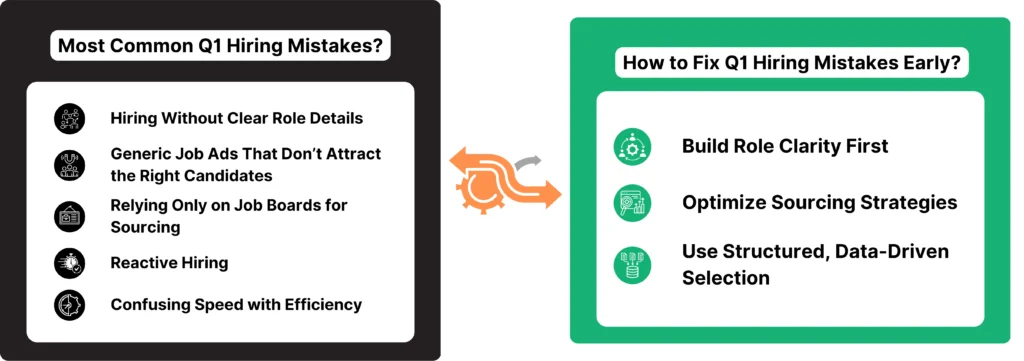
What Are the Most Common Q1 Hiring Mistakes?
Q1 hiring mistakes are similar to the bumps in the road that break momentum and slow down progress. But it’s important to note that one can always avoid them by being cautious. Below are the 5 most common hiring mistakes one should avoid:
1. Hiring Without Clear Role Details
Before you even think about creating a job posting, answer these questions internally:
- Why do we actually need this role right now?
- What specific problems will this person solve?
- What outcomes must this hire deliver in the next 6-12 months?
If you skip this step and start hiring just because you felt the need for a specific role, you’re very likely to end up with:
- A vague job description
- Mismatched candidates
- A poor hire that doesn’t solve the real need
- Wasted time, money, and energy
Hiring without a clear purpose and expected outcomes derails the team, drains resources, and moves you further away from business goals. It’s important to be clear about who needs to be hired before starting the process to save resources.
2. Generic Job Ads That Don’t Attract the Right Candidates
The hiring process never hits the goal without job ads; in fact, it’s mostly a hiring manager’s first step. An attractive job ad that shares all necessary details is better than a well-designed ad with missing information. The right candidate often ignores generic ads because they are looking for growth opportunities, not just jobs.

3. Relying Only on Job Boards for Sourcing
Hiring managers who rely solely on job boards for sourcing are missing out on quality talent pools present on platforms like LinkedIn. Hiring platforms have grown; the usual job boards are no longer the only sources of candidates. Top candidates are passively looking for jobs, and connecting with them requires building relationships through social platforms. Hence, relying only on one source is an outdated gameplan.
4. Reactive Hiring
Hiring only when the need arises is a reactive process. Being unprepared for hiring needs and leaving roles empty until a suitable candidate is found are reasons for momentum breakdown. Proactive hiring is the perfect remedy since it:
→ Protects resources
→ Avoids gaps
→ Saves time
The trick is to have a candidate pipeline ready because it’s always better to be overprepared when the next critical role opens.
5. Confusing Speed with Efficiency
Often, speed and efficiency are considered synonymous, but that’s inaccurate. Speed hiring fills roles fast, which can lead to cultural misfit and fast exits. It’s one step forward, two steps back. Alternatively, efficient hiring requires a bit more time upfront to recruit candidates who truly align with your needs, culture, and long-term goals, resulting in better retention rates. When hiring, especially in Q1, prioritize efficiency over speed for stronger, sustainable results.
How to Fix Q1 Hiring Mistakes Early?
Q1 hiring mistakes, if addressed early in the hiring process, can ensure zero workforce planning errors are made. However, a perfect hiring process can still lead to candidate dissatisfaction if it has a lengthy application with multiple interview rounds.

To correct Q1 hiring mistakes early, you need to refine the process from its inception. Below are some fixes one can apply to fix mistakes:
1. Build Role Clarity First
Before creating a job post, build clarity about the required role. Here’s a short checklist you can use to understand the requirement:
- What are the key outcomes for this role?
- Which skills are must-haves versus nice-to-haves?
- Who will this person work with, and what problems will they solve?
Once these questions are clear, creating a targeted job description will become easy.
2. Optimize Sourcing Strategies
Sourcing strategies can significantly alter the course of the hiring process. Top candidates are no longer actively seeking jobs; instead, they have become passive applicants. To tap into this talent pool, traditional sourcing strategies are no longer sufficient. Building genuine connections and fostering relationships is the key to optimizing sourcing strategies.
3. Use Structured, Data-Driven Selection
The final selection of candidates should be based on structured interviews and test results rather than gut feeling. Overreliance on your instincts can lead to poor decisions that can break your momentum and hurt your pipeline. Hiring decisions should be result-driven for the best output.
Investing in fixing hiring mistakes early in the hiring process snowballs into better hires, improved momentum, and an overall increase in business performance.
Conclusion
Q1 hiring mistakes often don’t come from poor intentions. They come from rushed decisions, unclear planning, and processes that haven’t kept up with how hiring actually works today. Companies that win in Q1 are the ones that plan early and build hiring systems that balance speed with quality.
That’s where the right hiring partner can make a real difference. BPO W. helps businesses design smarter Q1 hiring strategies, avoid costly early-year mistakes, and build teams that last. If you’re planning your next hiring cycle, now is the right time to get it right. Let’s talk about how we can support your Q1 hiring goals before urgency takes over.
FAQs
You should start planning for the Q1 hiring cycle at least 4-6 weeks before Q1 starts, but there is no definite timeline. Also, it’s a good practice to treat it as a strategic process rather than a sprint.
Prioritizing speed over quality is the most costly Q1 hiring mistake. Rushing to fill a position without clarity and a set standard causes high turnover and financial consequences.
A structured and intentional hiring process can balance speed and quality in the hiring process. To start with, clear objectives and filtering candidates without any bias can make the process efficient.
The best way is to have a strong onboarding strategy that starts with the interview process and ensures a smooth cultural integration through regular check-ins.
Structured interviews introduce fairness, consistency, and trust into candidate evaluation. They create a transparent process facilitating quality hire.