

Table of Contents
If you are a recruiter, you must be seeing a lot of problems in a fluctuating market. The good news is that you can start with focusing on one problem to magically fix the half of the rest and that’s the admin problem. In-house recruiters reportedly lose nearly two hours every day to administrative tasks that’s the equivalent of a full working day every single week. That’s time stripped away from the people and the connection part of talent acquisition work that actually moves the needle.
If you’re considering SourceWhale for recruiters, you are definitely feeling the lag already. Your outreach lives in one tool, your contact data in another, your call notes somewhere else, and your CRM is three steps behind all of it. The admin reduction stays a goal rather than a reality.
SourceWhale was built to hit that goal. It’s an AI-native Recruitment Productivity Platform that unifies sourcing, multichannel outreach, conversations, data management, meeting notes, and CRM into a single modular system, from first search to final placement.
This guide is the most comprehensive resource on SourceWhale currently published. It draws from 260+ verified G2 reviews, SourceWhale’s dataset of 100M+ outreach messages, direct competitor research across five alternative platforms, and independent data from Gartner. No matter if you’re evaluating SourceWhale for the first time, comparing alternatives, or looking to get more from a subscription you already have, this is your complete reference.
What Is SourceWhale?
The typical recruiter desk runs across four to six disconnected tools at once, i.e., a dialer for calls, a Chrome extension to pull contact data, a CRM to store it, WhatsApp for quick conversations, LinkedIn for sourcing, and a separate notes app to capture what was actually said on calls. None of these tools talk to each other natively. Every piece of context has to be moved manually, every update has to be typed in twice and every follow-up has to be remembered rather than automated.
So, it’s not a shock to read Gartner’s stats that mention how 70% of company contact data becomes obsolete annually, meaning the database your team spent years building is quietly degrading every single day as wrong numbers pile up, emails bounce and sequences fire at people who moved roles six months ago.
The deeper cost is the talent acquisition opportunities lost to the tasks that could have been outsourced. If not, recruiters witness a warm candidate go cold because a follow-up wasn’t logged or a client deal stalls because the context from the last call lives in someone’s notebook.
SourceWhale as the Answer
SourceWhale, rather than adding another tool to an already fragmented stack, replaces it. Every email sent, call made, WhatsApp exchanged, and meeting held is captured automatically and synced to your ATS integration or CRM in real time so you don’t have to indulge in manual data entry, tab-switching, and chasing updates. The platform handles data hygiene in the background, keeping contact records accurate and outreach-ready. It runs sourcing workflows, manages multichannel sequences, transcribes calls, logs meeting notes, and tracks pipeline, all from one place.
SourceWhale describes this as becoming a recruiter’s “second brain” as it pulls meetings, emails, calls, WhatsApps, and LinkedIn messages into one unified place, so nothing falls through the cracks and every relationship stays warm.
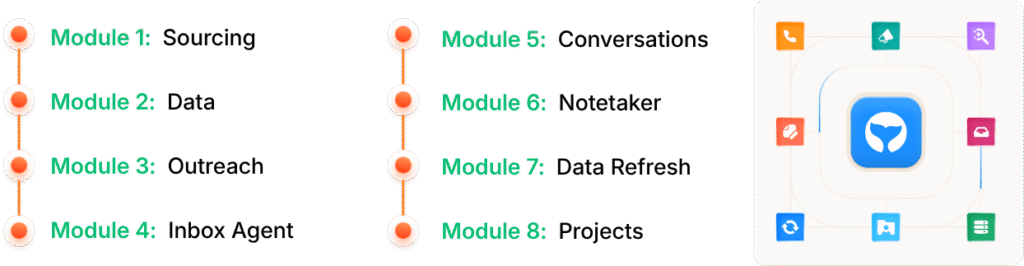
One important note for buyers comparing options: SourceWhale has significantly evolved since it launched. Co-founder and CEO Tim Hogwood has described the original mission as automating “the manual, repetitive tasks that take up so much of recruiters’ time”, but the platform has grown well beyond email automation. As of 2025, it operates as a full Recruitment Productivity Platform with eight distinct modules covering everything from AI-powered sourcing to meeting note-taking to CRM management. If you evaluated it a year or two ago as just an outreach sequencer, it’s a materially different product today.
Key Facts at a Glance
Who Uses SourceWhale? (And Who Should Look Elsewhere)
SourceWhale is not a general-purpose HR tool. It was built with a specific user in mind, the outbound recruiter whose revenue depends on starting conversations rather than managing job boards. Understanding whether you fit that profile before booking a demo will save you time on both sides.
The Recruiters Who Get the Most Out of It
66.4% of SourceWhale’s users come from the staffing and recruiting industry, making it overwhelmingly a tool chosen by professional recruiters rather than HR generalists or hiring managers. Within that, five user profiles consistently appear in reviews and case studies.
- Agency recruiters and staffing firms are SourceWhale’s primary audience. Whether you’re running a perm desk, a contract book, or both, the platform is built around the outbound BD and headhunting motions that define agency work with its multichannel sequences, candidate approach, MPC (Most Placeable Candidate) marketing, and client development at scale.
- Executive search consultants benefit from the platform’s personalization depth. High-fee and low-volume searches demand messaging that feels individual. WhaleGPT’s guided generation and the variable system let exec search practitioners do exactly that without spending an hour on each outreach.
- Solo billers and small desk recruiters use SourceWhale to compete at a level that previously required a full support team with automated follow-ups, AI-drafted messages, and Hotlist prioritisation which means that a single recruiter can maintain the touchpoint volume of a team of three.
- Fast-growing boutique agencies adopt SourceWhale as infrastructure that helps them replace the messy stack of separate tools with one connected system as they scale from three consultants to thirty, without adding proportional admin overhead.
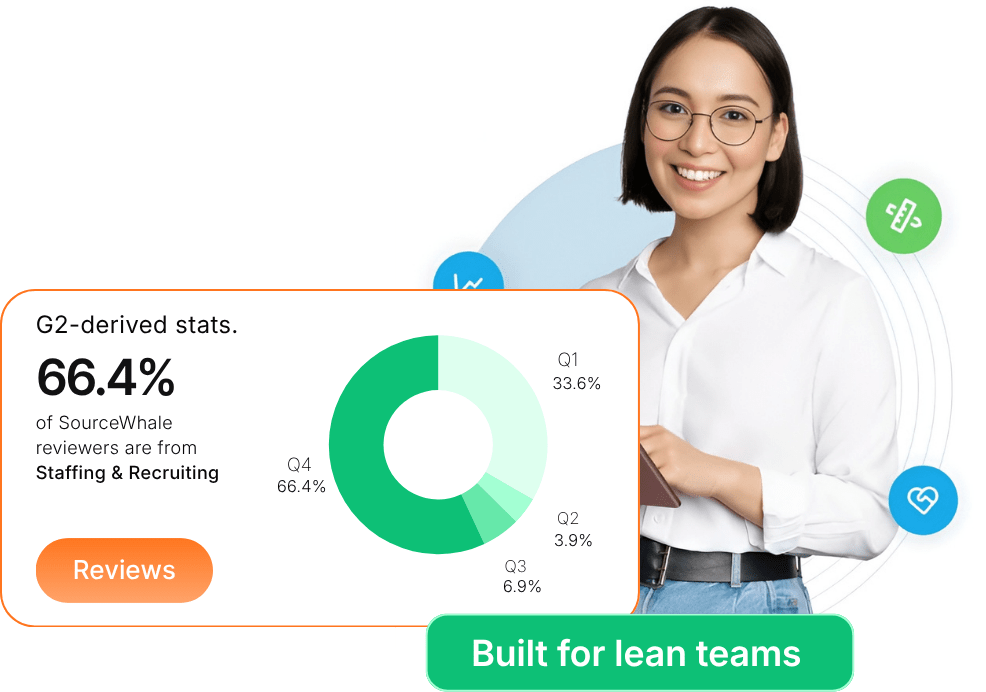
Company Size Fit (Data-Backed)
G2 reviewer breakdown by company size shows small-business (50 or fewer employees) accounts for 77.9% of SourceWhale’s reviews.
This distribution matters as SourceWhale is not architected around enterprise procurement cycles, IT-led integrations, or 500-seat rollouts. Its modular structure, fast onboarding, and no-credit-card free trials are designed for teams that need to move quickly and prove value fast. The 77.9% small-business concentration is, thus, a product signal. This is where the platform fits best and where reviews are most consistently positive.
Mid-market teams (51–1,000 employees) represent a growing segment at 19%, and the modular pricing model accommodates teams that want to start with two modules and expand. Enterprise adoption at 3.2% reflects the platform’s current focus rather than a ceiling, something worth monitoring as the product matures.
Who Should Look Elsewhere
SourceWhale is honest about its scope. Before buying, note the areas where it scores lower:
- On G2, SourceWhale scores 9.4 for Ease of Use and 9.5 for Quality of Support, but faces challenges in areas like interview scheduling and job posting, which are not core to its design. If structured applicant tracking, job board posting, or interview scheduling workflows are your primary requirements, SourceWhale will need to sit alongside a dedicated ATS rather than replace one.
- Large enterprises with 500+ recruiters needing a primary ATS and complex IT integrations should evaluate Greenhouse, Lever, or hireEZ as the anchor platform, with SourceWhale potentially layered on top for outreach.
- Teams operating on budgets under approximately $150/seat/month will find SourceWhale’s premium pricing a barrier, though the free trials for Inbox Agent and Notetaker offer a genuine no-commitment entry point.
- Purely inbound hiring functions with no outbound sourcing motion, where roles fill from job board applications alone, are prone to underutilizing the platform’s core capabilities.
SourceWhale Features: All 8 Modules Explained
SourceWhale now comes in flexible modules. You can either run the full platform or pick the modules that plug directly into your workflow, with everything syncing automatically back to your CRM or ATS. This modularity is one of SourceWhale’s most practically useful design decisions. You’re not forced to rip and replace your existing stack as it allows you to choose where to start, prove the value, and expand from there.
Every module connects directly which means that every email, call, and note automatically flows into your CRM without a single manual update. What follows is a complete breakdown of all eight modules, what each does, and why it matters to day-to-day recruiting work.
Module 1: Sourcing
The Sourcing module is where every workflow begins. It lets recruiters find the people they need from across the web and their existing CRM and ATS, without switching tools, Boolean syntax, and needing to manually cross-referencing multiple databases.
- The Chrome Extension is the primary interface for most sourcing activity. Recruiters can just run SourceWhale, find accurate contact details, and automatically add the prospect or candidate to a hyper-personalised message sequence that goes directly from their Outlook or Gmail, from wherever they are on the web.
- The Hotlist is the sourcing module’s intelligence layer as multiple G2 reviews mention it as a standout feature. It alerts recruiters when a contact is no longer part of a campaign and helps prioritise who to contact next based on engagement signals and interaction history. It even tells you who is warm right now, making itself the highest-ROI five minutes of a recruiter’s day.
- The best part is that the SourceWhale’s search operates on plain language, not Boolean. Where tools like hireEZ require Boolean string construction, SourceWhale translates everyday recruiter language into results. You type the profile you’re looking for and it responds with the matches. This is semantic search applied to recruitment sourcing, and it meaningfully lowers the skill barrier for new consultants while speeding up experienced ones.
Module 2: Data
Great outreach is worthless if it fires at the wrong inbox. The Data module solves the contact intelligence problem at the point of sourcing, before a bad email address ever enters your pipeline.
SourceWhale’s Data module uses a smart waterfall process that searches 10+ top data providers to deliver the most accurate emails and phone numbers that are synced straight to your ATS or CRM. One click pulls verified contact details and no credits wasted on duplicates across multiple subscriptions.
Up to 70% of contact data goes stale every year, costing recruiters time, opportunities, and client relationships. The Data module addresses this at the point of entry which ensures every new contact added to your pipeline starts with accurate, verified details rather than inheriting the decay problem from day one. (Data Refresh, covered in Module 7, handles the records already in your CRM.)
Module 3: Outreach
The Outreach module is SourceWhale’s flagship as it’s the feature that singlehandedly built the platform’s reputation and the one most users adopt first. It’s also where the gap between SourceWhale and simpler email sequencing tools becomes most visible.
The Outreach module makes it easy to book more meetings, place more candidates, and win more business. It makes not just possible, but quite easy to create smart, high-converting sequences across email, LinkedIn, SMS, WhatsApp, and phones that automatically run in the background so your team can focus on building human connections.
- Multichannel sequences are the core of any recruiting process. A sequence in SourceWhale is a coordinated, multi-step campaign that can include email, LinkedIn connection requests and InMail, phone calls, SMS, and WhatsApp, all timed and personalized, ready to run automatically once launched.
- WhaleGPT is the AI engine that powers message creation. WhaleGPT was developed specifically for recruitment outreach and it has been trained on high-performing recruitment messaging data from the SourceWhale platform that makes it different from other generic AI platforms. The result is an AI that understands recruiter tone, BD language, MPC marketing copy, and how passive candidates are approached without needing the recruiter to become a prompt engineer. Just a guided question flow, role, context, target profile, produces customized and ready-to-use message drafts in seconds.
- Campaign AI takes this further with entire multi-step multichannel campaigns using best-practice methodology derived from the platform’s dataset. New consultants follow proven frameworks on day one and experienced recruiters launch even faster.
- Content Coach sits alongside both tools as a real-time quality gate. Before any message is sent, Content Coach analyzes subject lines, wording, reading time, personalization variable usage, and spam phrase risk, flagging issues and scoring quality. The typical recruiter spends more than 30 minutes every day chasing updates on in-progress roles, per SourceWhale’s own published data — Content Coach ensures the messages that do go out are as effective as possible so fewer follow-ups are needed.
- AI To-Dos are one of the most underappreciated features in the platform. The system reads outgoing and incoming email language for natural commitment phrases, “I’ll call you Thursday,” “Let’s speak next week”, and automatically creates a task in the recruiter’s to-do list. Even verbal commitments become logged action items without the recruiter touching a task manager.
- The real-time performance dashboard closes the loop with open rates, reply rates, response reasons, A/B test results, engagement patterns, and team benchmarks all visible in one view. The analytics are unexpectedly valuable, making everything clear in one glance.
Module 4: Inbox Agent
Inbox Agent powers up your Outlook or Gmail inbox with automated and personalized nudges, real-time AI feedback on your email copy, and live tracking of opens and clicks, so recruiters never lose deals to slow responses or missed reminders.
Inbox Agent is best understood as agentic AI in practice as it lives natively inside your existing email client and autonomously handles the classification, drafting, and follow-up tasks that currently eat into recruiter time. Three core functions define this module:
- First, automated follow-up sequences attach personalised follow-up nudges to any email and Inbox Agent fires them on schedule. Waiting for interview feedback, a contract signature, or a meeting confirmation? The follow-up handles itself.
- Second, reply categorization and AI drafting helps inbox agent automatically categorize candidate replies, draft suggested responses, and flag next steps so nothing goes missed.
- Third, real-time email coaching blows minds with live feedback on copy quality as you write. Spam phrase warnings, subject line suggestions, and engagement scoring surface directly in the compose window before you hit send.
Users who bundle both Inbox Agent and Notetaker see an 86% increase in productivity on average, per SourceWhale’s own data, and both are available as standalone free trials with no credit card required.
Module 5: Conversations
The Conversations module lets recruiters call, text, and WhatsApp directly from SourceWhale, with everything logging automatically to the CRM. No copy-pasting. No missed details. With real-time transcriptions and AI summaries, nothing is ever lost. SourceWhale
The Conversations module eliminates the biggest gap in most recruitment stacks: the phone call. Every call made, text sent, and WhatsApp exchanged from SourceWhale is automatically captured and synced to the right contact record in your ATS or CRM in real time. Managers get full visibility across the team’s communication activity — not just what was sent, but what is driving results.
The integration with the Outreach module creates a particularly powerful use case: call a candidate the moment they open your campaign email. Engagement signals from Outreach are visible in Conversations, meaning recruiters can act on interest at exactly the right moment rather than waiting for a response that may not come.
Real-time call transcription means note-taking during calls becomes optional. AI-generated summaries are produced automatically and posted to the CRM without any manual input — preserving every detail from every call without the recruiter ever picking up a pen.
Module 6: Notetaker
Notetaker joins calls, writes them up properly with recruiter-specific templates, and lets recruiters interrogate the call afterwards with AI which automatically turns every meeting from a potential memory leak into a structured, searchable, actionable record.
The Notetaker joins Zoom, Google Meet, and Microsoft Teams meetings without any manual invite or recording setup required. It also works with external dialers including Aircall, RingCentral, and Ringover for phone-based meetings, meaning it captures across virtually every communication format a recruiter uses.
What distinguishes Notetaker from generic transcription tools is its recruitment-specific template library. Transcripts are processed using templates designed for intake calls, BD calls, candidate interviews, reference checks, and client reviews, so the AI summary reflects the structure of each meeting type rather than a generic “action items” list.
The Notetaker module goes beyond transcription as it turns every conversation into structured insights you can act on. Ask questions, surface takeaways, trigger follow-ups. Instead of just having notes, you get a concrete plan-of-action.
All notes, transcripts, and summaries auto-log to the correct contact record in your ATS or CRM without any manual input. You can then share recordings, transcripts, or summaries directly with clients or candidates post-meeting.
Module 7: Data Refresh
Data Refresh addresses a problem that every recruiter knows exists but most tools ignore entirely. Data Refresh automatically validates, updates, and enriches the contact data in your CRM and ATS, helping recruiters re-engage candidates and clients faster, personalize outreach more effectively, and spend more time on tasks that really get the ball rolling.
The scale of the problem makes this module more important than it first appears. With a huge amount of data going stale every year, a database built over five years of agency work is, statistically, more than two-thirds inaccurate. Every bounced email, every wrong number, every outreach sequence that fires to a candidate who changed roles twelve months ago represents lost time and damaged domain health.
Data Refresh runs silently in the background without any manual process, periodic cleanup project or data team required. It continuously validates and enriches every contact record in your existing CRM, flagging outdated entries and restoring accuracy without disrupting active workflows. The result is a self-maintaining database that stays outreach-ready rather than slowly degrading into an expensive liability.
Module 8: Projects (The Admin-Free CRM & ATS)
SourceWhale uses AI to capture every call, email, meeting, and note that helps it automatically connect that activity across candidates, clients, and projects without having you enter any data or chase updates.
“Projects” is SourceWhale’s built-in CRM and ATS module, designed specifically for agencies and startups that want the power of a modern recruitment system without the administrative overhead that typically comes with it. Every interaction captured by Outreach, Conversations, Inbox Agent, and Notetaker automatically flows into Projects in real time. There is no manual logging because there is no manual step.
SourceWhale integrates seamlessly with more than 70 ATS and CRM tools, like Bullhorn, Vincere, Greenhouse, Lever, JobAdder, PCRecruiter, SmartRecruiters and more. If you already have an ATS your team uses and trusts, keep it. SourceWhale connects to it and feeds it data automatically. This module is the right choice for teams who want to consolidate their stack entirely or who are building their infrastructure from scratch.
For teams switching to Projects from another CRM or ATS, every Projects customer gets hands-on onboarding and ongoing support from SourceWhale’s Customer Success team, plus access to documentation, training sessions, and new feature updates.
SourceWhale's AI Engine: NLP, Generative AI & Agentic Features Explained
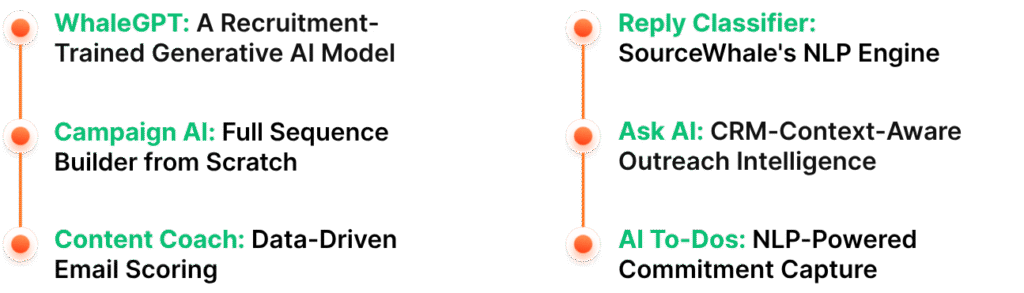
SourceWhale is AI-native because AI isn’t a feature layer bolted onto an existing tool, it’s threaded through every module from the ground up. That’s why it consistently outperforms generic tools that use off-the-shelf language models with a recruitment skin applied.
Our recruiters are quite impressed by the six distinct AI systems inside SourceWhale that we’ll now discuss.
WhaleGPT: A Recruitment-Trained Generative AI Model
WhaleGPT is a text-generation tool designed specifically for recruiters. It mimics how recruiters engage with contacts, trained on a rich dataset of high-performing outreach, so it generates text that will drive high open, interest, and meeting rates.
The distinction from generic AI tools particularly matters here. Tools like ChatGPT simply lack context when it comes to reaching out to candidates or clients and don’t understand the many downsides that come with it. WhaleGPT was built to fill exactly that gap, being trained on high-performing recruitment outreach data. It understands recruiter tone, language and all what matters in the business.
Recruiters can easily generate professional, personalized outreach abundantly with guided prompts tailored to headhunting and business development . They can choose tones, refine messaging, and get multiple content options for initial outreach or follow-ups. The best part is that the WhaleGPT’s learning capability improves alignment with your individual style over time.
The workflow is quite simple; WhaleGPT provides a structured question flow that recruiters answer to create unique BD or headhunting messaging, then kickstarts the campaign with an AI-generated draft that can be regenerated or refined. The recruiter provides context and WhaleGPT generates ready-to-use message variants in seconds.
Campaign AI: Full Sequence Builder from Scratch
Building outreach campaigns from scratch is complex and time-consuming. Campaign AI makes it easy to quickly generate entire multi-step, multichannel, best-practice outreach campaigns in moments.
Where WhaleGPT generates individual messages, Campaign AI builds the entire campaign architecture that includes channel selection, sequence steps, timing gaps, and content drafts, using best-practice methodology derived from SourceWhale’s outreach dataset. A new consultant can launch a properly structured, multi-step, multichannel campaign on their first day and an experienced recruiter can spin up a campaign for a new role in minutes rather than hours.
Content Coach: Data-Driven Email Scoring
Trained on the analysis of over 21.8 million pieces of outreach sent via the SourceWhale platform, Content Coach scores your messaging content and offers data-backed recommendations to optimize your outreach and achieve better outcomes.
Content Coach analyzes every message in real time before it sends, assessing messaging and providing data-driven recommendations to enhance outreach efforts, covering wording, subject lines, custom variables, reading time, and avoiding spam phrases.
The specific thresholds are precise and documented:
- Subject lines should be under 60 characters
- Emails should contain no spam phrases (including words like “opportunity” or “urgent”)
- Initial outreach emails should be under 700 characters
- Follow-ups under 400 characters
- No more than 2 links
- At least 3 custom fields
- Written at US Grade 8 reading level or below.
Achieve a score of 85 or more to achieve better engagement, more meetings, and higher revenue. The model is continually fed with updated techniques, so recruiters can write confidently knowing the most effective methods that win in today’s market are at their fingertips.
Reply Classifier: SourceWhale’s NLP Engine
SourceWhale AI’s Reply Classifier automatically sifts through the responses you receive, categorizing replies into “interested” and “not interested.” It also recognizes when your outreach gets an “out of office” reply and pauses further steps until the date the reply says the contact is back at work, freeing recruiters to focus on those who are actively interested.
The NLP layer goes deeper than simple categorization as the feature uses natural language processing to identify the story behind a “not interested” response, with a variety of pre-set reasons such as compensation, location, and job fit, plus the ability to add custom reasons specific to the markets you serve. This helps identify common themes why candidates might be declining.
In technical terms, this is intent detection and sentiment classification applied directly to recruiter outreach. Candidates who reply with interest are surfaced for immediate follow-up and those who are genuinely not interested are removed from active sequences.
Ask AI: CRM-Context-Aware Outreach Intelligence
Ask AI pulls key context from your CRM and SourceWhale interaction history to help you write better emails and make stronger calls.
Ask AI addresses a specific and common recruiter failure mode by reaching out to a warm contact without remembering the history, or calling a client without reviewing what was discussed on the last call. Ask AI surfaces that context automatically at the moment of action without any digging through contact records, or scrolling through email threads. So, every message and every call starts from a position of informed relevance rather than cold re-introduction.
AI To-Dos: NLP-Powered Commitment Capture
AI To-Dos picks up on phrases like “I’ll call you tomorrow” in your emails and adds them to your task list automatically, keeping recruiters on top of every commitment.
The system reads the natural language of outgoing and incoming email content, detects phrases that imply a future commitment or action, and creates a corresponding task without the recruiter touching a task manager. A verbal agreement made in an email body becomes a logged action item automatically.
The value is disproportionate to how simple it sounds. The single most common reason warm candidates go cold and deal stall in recruitment is a missed follow-through. AI To-Dos eliminates that failure mode entirely by ensuring that every commitment made in writing is captured and actioned.
How to Build a Winning Outreach Sequence in SourceWhale
The Outreach module gives you the infrastructure. This section of our guide gives you the strategy to make it work, drawn directly from SourceWhale’s own best-practice documentation, platform data from 100M+ outreach messages, and the do’s and don’ts guide published by SourceWhale’s own team.
Why Single-Channel Outreach Fails in 2026
The data on this is clear-cut. When you pair a multichannel approach with hyper-personalized messaging, you’re looking at a major jackpot, watching response rates skyrocket from a sluggish 18% to a whopping 34.5%. A massive 71% of those conversations only happen because of a solid follow-up strategy.
A single email sent once is a lottery ticket. The recruiters consistently booking the most meetings are the ones who reach candidates across multiple channels, across multiple touchpoints, with messages that feel individually written even when they’re running automatically at scale.
SourceWhale recommends having between 3–4 email steps in your campaigns (depending on your region’s formalities), using auto-email follow-ups to increase chances of replies through multi-channel outreach such as augmented LinkedIn and phone call steps.
The goal of multichannel sequencing is to give them every reasonable opportunity to engage on the channel they prefer, at a time that works for them, with a message that demonstrates genuine intent.
The Proven 5-Step SourceWhale Sequence Blueprint
All guidance below is sourced directly from SourceWhale’s official best practice documentation and help centre.
Personalization That Actually Moves the Needle
The single most impactful thing a recruiter can do to improve reply rates costs nothing extra and takes thirty seconds per message. Writing a personalized sentence in each message increases reply rate from an average of 18% to 34.5%. It only has to be a sentence that references something from their profile or CV, or mentions a particular piece of content they have interacted with recently. Put the personalization in the first line of the email so the reader engages straight away and is more inclined to read on.
Beyond that opening sentence, use three or more variables in each message in your sequence to ensure there is personalization throughout the entirety of your outreach.
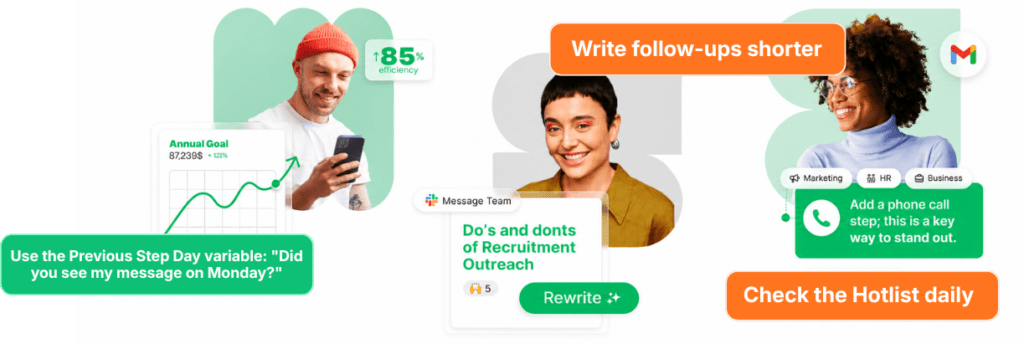
SourceWhale’s variable system goes well beyond first name and company. The “Previous Step Day” variable automatically references the day of the previous step in natural language, “yesterday,” “last Wednesday,” “a couple of weeks ago”, so follow-ups feel handwritten rather than templated, without the recruiter manually checking when the last email went out.
Create custom images with the candidate’s name or company name built directly into the graphic from the campaign editor. This level of apparent effort, a personalized image, dramatically increases the chance of a response from a contact who has ignored every previous step.
Email Deliverability: What Most Recruiters Ignore Until It’s Too Late
Deliverability is the invisible variable that determines whether your outreach is working. A sequence with a 35% open rate and a 12% reply rate is performing. The same sequence, fired at poor-quality data from a domain that’s been flagged as spam, will produce 2% open rates and zero replies merely because the emails aren’t reaching inboxes.
Creating a targeted and well-researched list is mission-critical in order to maximize open and reply rates and maintain strong email domain credibility. Volume without quality is the fastest route to domain damage and no one wants that.
Content Coach’s pre-send checks address the most common deliverability killers. Fix those before sending, not after your open rate has dropped and your domain is flagged.
The broader principle demands replies from the audience to protect domain health. Every reply, even a “not interested”, signals to email providers that your messages are wanted. The Reply Classifier captures all of them, removes uninterested contacts from sequences, and keeps your active campaigns focused on contacts who are genuinely worth pursuing.
Critical Do’s and Don’ts of Recruitment Outreach
SourceWhale Integrations: Does It Work With Your Stack?
SourceWhale is designed to plug into your existing workflow rather than replacing it by force. It fits into your tech stack as the outreach and engagement layer, sitting alongside your ATS for applicant tracking, your CRM for relationship management, and your sourcing tools for candidate discovery, with bidirectional sync keeping everything current without manual updates.
ATS & CRM Integrations
SourceWhale’s full integration list spans Bullhorn, CATS, Chameleon-i, ClickUp, Clockwork, Copper, Crelate, Dynamics, eBoss, Exelare, Ezekia, Google Contacts, GoHighLevel, Greenhouse, Homerun, HubSpot, Invenias, itris, JazzHR, JobAdder, JobDiva, Jobvite, Kortivity, Lever, Loxo, Manatal, Mercury, PCRecruiter, Personio, Pinpoint, Podio, Recruit CRM, Recruitee, Recruiterflow, Salesforce, SmartRecruiters, Taleo, Teamtailor, Vincere, Voyager Infinity, Workable, Zoho CRM, Zoho Recruit and more. G2
Every integration is bidirectional and activity from SourceWhale flows back into your ATS automatically. Emails, calls, notes, WhatsApps, and meeting summaries all land on the correct contact record without a single manual step.
One practical note from G2 reviewers mentions that adding a candidate from the Chrome extension or search view currently requires first adding them to “People” before pushing to Bullhorn, an extra click that SourceWhale is aware of and actively working to streamline. Worth knowing before a Bullhorn-heavy rollout.
Communication & Video Integrations
- Email: Gmail and Outlook; Inbox Agent lives natively inside both
- LinkedIn: InMail and connection requests as sequence steps within campaigns
- Calls/SMS/WhatsApp: via the Conversations module; all auto-logged
- Video: Zoom, Google Meet, Microsoft Teams; Notetaker joins automatically
- Dialers: Aircall, RingCentral, Ringover; Notetaker captures these calls too
Data Provider Integrations
Almost half of SourceWhale’s integrations are with contact data providers and enrichment tools, the waterfall system that searches 10+ providers simultaneously for the most accurate verified contact details. This replaces the need to maintain separate subscriptions to individual data tools.
What If Your Tool Isn’t Listed?
SourceWhale integrates with ATS, CRM, and email platforms across 100+ tools in total. If your specific platform isn’t on the public list, ask during the demo because the integration library expands regularly and custom connections are available for enterprise configurations.
SourceWhale Pricing: What Does It Cost in 2026?
SourceWhale does not publish pricing publicly. A demo call is required for a customized quote, which is standard practice for platforms at this tier.
What the Market Data Shows
Two independent sources provide directional estimates:
- Software Finder estimates SourceWhale pricing at $200–$290 per user per month, in line with industry benchmarks for similar HR and recruiting software, noting actual costs may vary based on number of users, selected modules, and implementation requirements.
- Vendr’s transaction data from completed SourceWhale deals shows a minimum of approximately $3,300 and a maximum of approximately $17,000 annually, with an average contract value around $12,000 per year.
Both are third-party estimates. Neither is official SourceWhale pricing. So, you can use them for budgeting context only rather than getting a direct quote before committing.
G2 reviewer data shows an average implementation time of one month and an average ROI payback period of six months, which provides a useful planning benchmark for finance and ops sign-off conversations.
Free Trials: Where to Start Without Committing
Rather than waiting for a full platform demo, two modules are available as standalone free trials with no credit card required: Inbox Agent and Notetaker. Both deliver measurable value within the first week. Starting here de-risks the evaluation significantly.
How to Calculate ROI Before You Buy Sourcewhale
The honest ROI case for SourceWhale requires one number and that’s the recruiter’s billable hour worth.
For most agencies with average placement fees, a single extra placement per recruiter per month covers the full annual subscription. The time-saving case alone, 8+ hours/week at agency billing rates, typically produces a multiple of the subscription cost in recovered capacity.
Guide | Download its PDF version for more details on ROI calculations
SourceWhale Reviews: What Real Recruiters Say in 2026
Platform Scores at a Glance
SourceWhale vs Competitors
According to G2, SourceWhale’s top alternatives are Gem (4.7 stars with 259 reviews), hireEZ (4.6 stars with 254 reviews), and SeekOut (4.5 stars with 759 reviews). Here’s an honest breakdown of each comparison based on verified G2 data.
SourceWhale vs Gem
G2’s direct comparison shows SourceWhale ahead on Ease of Use (9.4 vs 9.2), Ease of Admin (9.4 vs 9.2), and Meets Requirements (9.2 vs 9.0). Gem edges SourceWhale on applicant tracking and interview scheduling, areas SourceWhale explicitly doesn’t prioritize as much.
G2 reviewers highlight SourceWhale’s ability to send tailored emails in bulk while maintaining personalization as a key differentiator over Gem, which reviewers see as stronger for ATS-led hiring pipeline management.
SourceWhale vs hireEZ
G2’s comparison shows SourceWhale leads hireEZ on Ease of Use (9.4 vs 9.1), Quality of Support (9.5 vs 9.3), and overall G2 score (4.8 vs 4.6). hireEZ leads on Ease of Setup (9.4 vs 9.2).
G2 reviewers say SourceWhale excels in user experience and AI features like the Notetaker, while hireEZ stands out for robust ATS integration capabilities and strategic data insights for specialized roles.
SourceWhale vs LinkedIn Recruiter
G2’s comparison shows LinkedIn Recruiter rated 4.5 stars from 421 reviews, with its primary market being mid-market (44.2%). SourceWhale outscores it on quality of support.
G2 reviewers say LinkedIn Recruiter excels at precise candidate search and “open to work” filtering, while SourceWhale leads on personalized bulk outreach and support responsiveness.
SourceWhale vs Loxo
G2’s comparison shows SourceWhale ahead on every scored dimension: Ease of Use (9.4 vs 9.1), Quality of Support (9.5 vs 8.8), Ease of Setup (9.2 vs 8.7), and Meets Requirements (9.2 vs 8.9). Loxo’s standout is AI-powered candidate matching and its free plan.
G2 reviewers describe Loxo as strong for AI-driven candidate matching and full ATS/CRM consolidation, while SourceWhale wins on user-friendliness, support quality, and outreach personalisation.
SourceWhale vs SeekOut
SeekOut’s primary market is enterprise (55.9% of reviews), compared to SourceWhale’s small-business focus (77.9%). SeekOut is rated 4. stars from 759 reviews and is praised for diversity sourcing, Boolean search, and power filters for hard-to-fill roles.
G2 reviewers say SeekOut is a strong partner for moving away from LinkedIn dependency in sourcing, while SourceWhale’s AI Notetaker and outreach automation are cited as productivity game-changers.
Comparison Table
Getting Started With SourceWhale: Onboarding & Week-One Quick Wins
G2 reviewer data shows an average implementation time of one month that is quite fast for a platform replacing multiple tools simultaneously.
Every customer gets a dedicated Customer Success Manager. Onboarding includes hands-on training sessions, CRM/ATS migration support, Chrome extension setup, and email client connection. Reviewers consistently describe being able to start sourcing candidates almost immediately after setup, with minimal training required.
For teams migrating from another CRM or ATS into Projects, migration is guided by SourceWhale’s team. The onboarding scope includes data transfer, workflow setup, and team training, all before go-live.
Power Sourcewhale User Habits
- Copy a top-performing colleague’s campaign before building from scratch; the campaign copy feature saves significant setup time and is consistently underused by new joiners.
- Combine Conversations + Outreach. so the moment a contact opens your campaign email, you’re notified. Call them then because timing is the variable most recruiters never optimize.
- Set AI To-Dos as a safety net on every client email. Any commitment made in writing becomes a logged task automatically, and nothing that’s been agreed slips through.
- Use SourceWhale for email sequences specifically to avoid the LinkedIn InMail “black hole”. Email consistently outperforms InMail on reply rate per sequence step.
Is SourceWhale Right for You?
Buy SourceWhale If…
- You’re an agency recruiter or staffing firm doing active outbound BD and headhunting
- Your team currently runs 3+ separate tools for sourcing, outreach, and CRM, and context is constantly falling through the gaps between them
- You want to scale outreach volume and personalization without scaling headcount
- You need multichannel sequencing, email, LinkedIn, calls, SMS, WhatsApp, that runs automatically while feeling individually written
- You value class-leading support (9.5/10 on G2) and want a vendor that ships new features based on customer input
- You want AI built specifically for recruitment rather than a generic LLM tool with a recruitment skin
Look Elsewhere If…
- Job posting, structured ATS, or interview scheduling are your primary requirements. SourceWhale’s G2 scores in these areas (5.4 and 6.0) as well as our own experience signal that these areas still require improvement,
- You’re a large enterprise (500+ recruiters) needing a primary ATS with complex IT governance requirements
- Your budget is under ~$150/seat/month; SourceWhale is premium tier and its pricing reflects it.
- You’re a purely inbound function with no outbound sourcing motion; the platform’s core value is in what it does for outbound.
The Verdict
SourceWhale earns its 4.8/5 across 260+ reviews. For agency recruiters and staffing firms, its designed-for audience, it is the most complete outreach and productivity platform available in 2026. The eight-module architecture, recruitment-trained AI, NLP-powered reply classification, and best-in-category support score give it a meaningful edge over broader, less specialized competitors.
The pricing is premium. The cancellation process has drawn criticism. And it requires a complementary ATS if structured applicant tracking matters to your workflow. But for the recruiter whose revenue depends on starting more conversations, filling more roles, and eliminating the admin tax on every working hour, the ROI case is clear and the evidence base is solid.
FAQs:
SourceWhale is an AI-native Recruitment Productivity Platform that unifies sourcing, multichannel outreach, calls, SMS, WhatsApp, meeting notes, contact data management, and CRM into one modular system. It automates admin and helps recruiters make more placements by keeping every contact, conversation, and commitment in one place, synced to your ATS in real time.
SourceWhale uses custom pricing with no public rate card. Third-party estimates (Software Finder, 2026) suggest approximately $200–$290 per user per month for SMB deployments. Vendr transaction data shows annual contracts ranging from ~$3,300 to ~$17,000. Contact SourceWhale directly for a tailored quote. Free trials are available for Inbox Agent and Notetaker without a credit card.
Yes . Free trials are available for two standalone modules: Inbox Agent (inside your Gmail or Outlook) and Notetaker (for Zoom, Google Meet, Teams, and external dialers). No credit card is required for either. However, there is no full platform free trial or permanent free plan.
SourceWhale integrates with 100+ tools total, including Bullhorn, Vincere, Greenhouse, Lever, JobAdder, PCRecruiter, SmartRecruiters, Salesforce, HubSpot, Loxo, Manatal, Zoho Recruit, Workable, Jobvite, and many more. It also integrates with Gmail, Outlook, LinkedIn, Zoom, Google Meet, Teams, Aircall, RingCentral, and Ringover.
They serve different functions. LinkedIn Recruiter is a candidate sourcing database. SourceWhale is a multichannel outreach and engagement platform. Most high-performing agencies use both: find candidates on LinkedIn, engage and convert them through SourceWhale sequences. They are complementary!
Yes, extensively. SourceWhale’s AI features include: WhaleGPT (fine-tuned LLM for recruitment outreach), Campaign AI (full multichannel sequence generation), Content Coach (email quality scoring trained on 21.8M outreach messages), Reply Classifier (NLP-based intent detection on incoming replies), Inbox Agent (agentic AI in Gmail/Outlook), Ask AI (CRM-context-aware outreach prep), AI To-Dos (NLP commitment detection from email language), and Notetaker (AI transcription with entity extraction and CRM auto-population).
WhaleGPT is SourceWhale’s proprietary generative AI message generator, a large language model fine-tuned on high-performing recruitment outreach data from the SourceWhale platform. Unlike generic AI tools, it understands recruiter tone, BD language, MPC marketing, and passive candidate approach without requiring prompt engineering from the user.