

Table of Contents
The age-old 360-degree recruiting model is kind of exhausting when you actually live inside it.
If you run a US boutique agency or manage a talent acquisition team in places like Silicon Valley or Austin, you already know the rhythm. And it’s exactly why offshore sourcing pods are becoming a smarter way to scale recruitment. Here, ‘recruiting’ in the true context is switching on steroids.
Recruiters are expected to do everything. One minute they’re in a client intake call trying to sound like an advisor, the next they’re deep in a Boolean string, then cleaning up ATS data that looks like it hasn’t been touched since 2017, and somehow still expected to close senior talent by EOD.
This efficiency is a bit of a mess.
Why US Recruiting is Broken
According to Staffing Industry Analysts (SIA), the US staffing industry is a $180B+ market, and competition for skilled talent has only increased in high-growth sectors such as tech and healthcare. But the delivery models these agencies use haven’t evolved at the same speed as the market they serve.
So the pressure goes up, but the operating system stays the same. That’s where things start breaking.
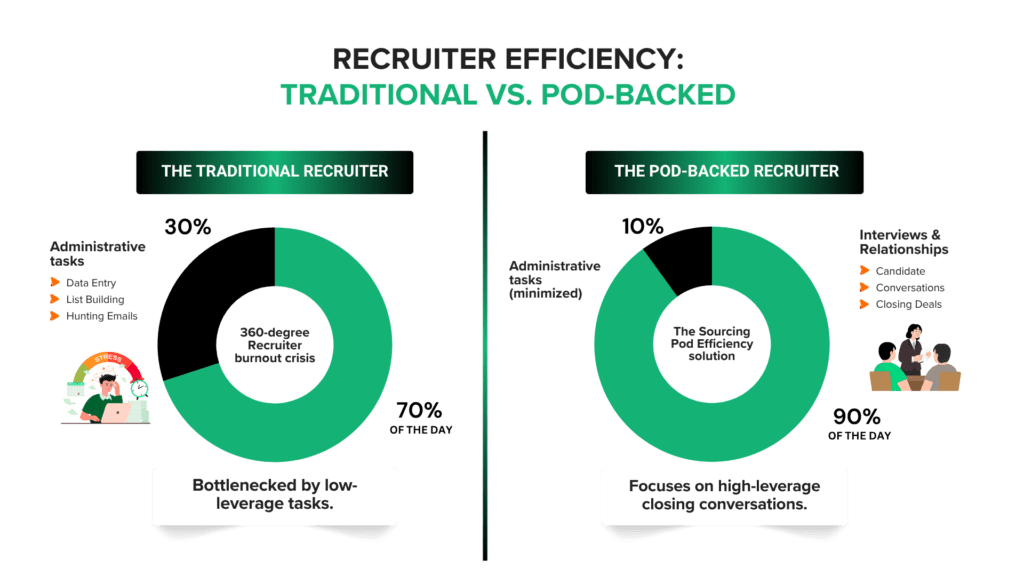
When you force a high-performing recruiter to do everything, calling it full ownership, it actually results in a clogged backlog and a burnt-out person. Recruiters spend a disproportionate amount of time on non-revenue-generating tasks, often 60–80% of their week, on sourcing prep, admin work, and data cleanup rather than actual candidate engagement.
Instead of interviewing candidates or closing roles, your most expensive resource is stuck:
- Building endless lists
- Hunting down emails that bounce anyway
- Fixing duplicate ATS entries
- Reformatting profiles for the fifth time
It’s not that recruiters can’t do it. It’s that they shouldn’t be doing all of it. Because every hour spent on admin is an hour not spent in revenue-generating conversations.
The High Cost of Administrative Bottleneck in US Tech Hubs
This gets expensive fast in markets like San Francisco, New York, or Austin. BLS data shows that wage pressure in professional recruiting roles has increased alongside demand for tech talent. And in parallel, time-to-fill for specialized roles in engineering and product continues to stretch, especially for senior-level hires. So you’re paying premium US salaries in premium markets, for work that is often low-leverage.
Every hour your senior recruiter spends fixing CRM records or sourcing from scratch is an hour they’re not:
- Closing candidates
- Advancing interviews
- Or building client trust
If a startup needs 15 engineers yesterday, nobody is waiting for your ATS cleanup to finish before they engage another agency. And here you will lose deals only because you’re slow.
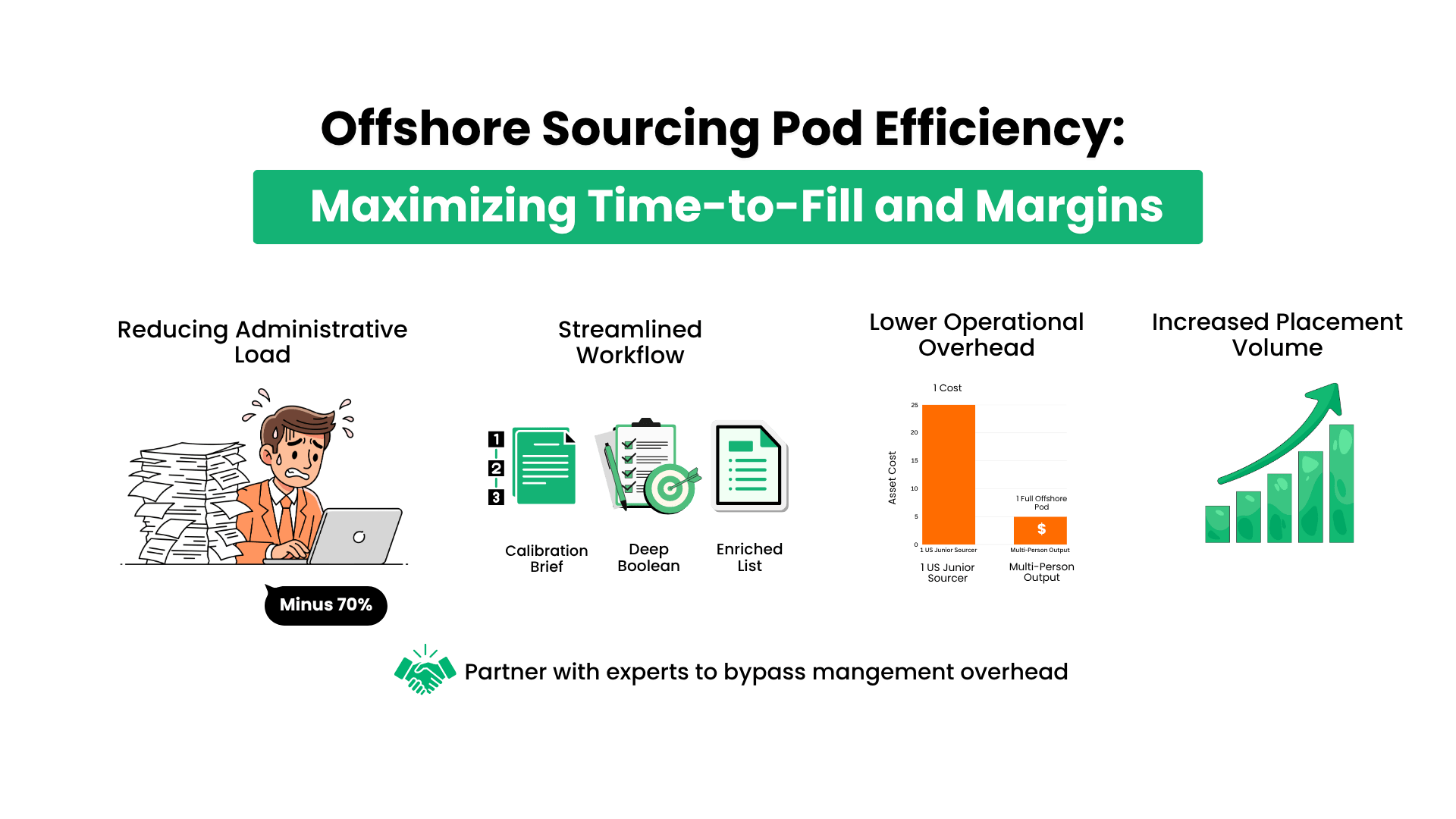
The Solution: Shifting from Individual Labor to Pod Architecture
Now this is where high-performing agencies are evolving. Instead of making every recruiter a ‘do-everything operator,’ they’re going towards pod-based delivery models focused on candidate velocity.
The idea is to stop mixing high-value and low-value work in the same brain at the same time. Decouple sourcing from closing. Decouple data from relationships. Because when everything is mixed together, nothing moves fast. Pods are production systems for talent, not individual hero-driven workflows. And once you see it that way, it’s hard to unsee it.
What is an Offshore Sourcing Pod?
Don’t overthink the term. It’s simpler than it sounds.
An offshore sourcing pod is basically a coordinated micro-team that runs like a small production unit. Instead of one recruiter doing everything, you split the workflow into specialized roles.
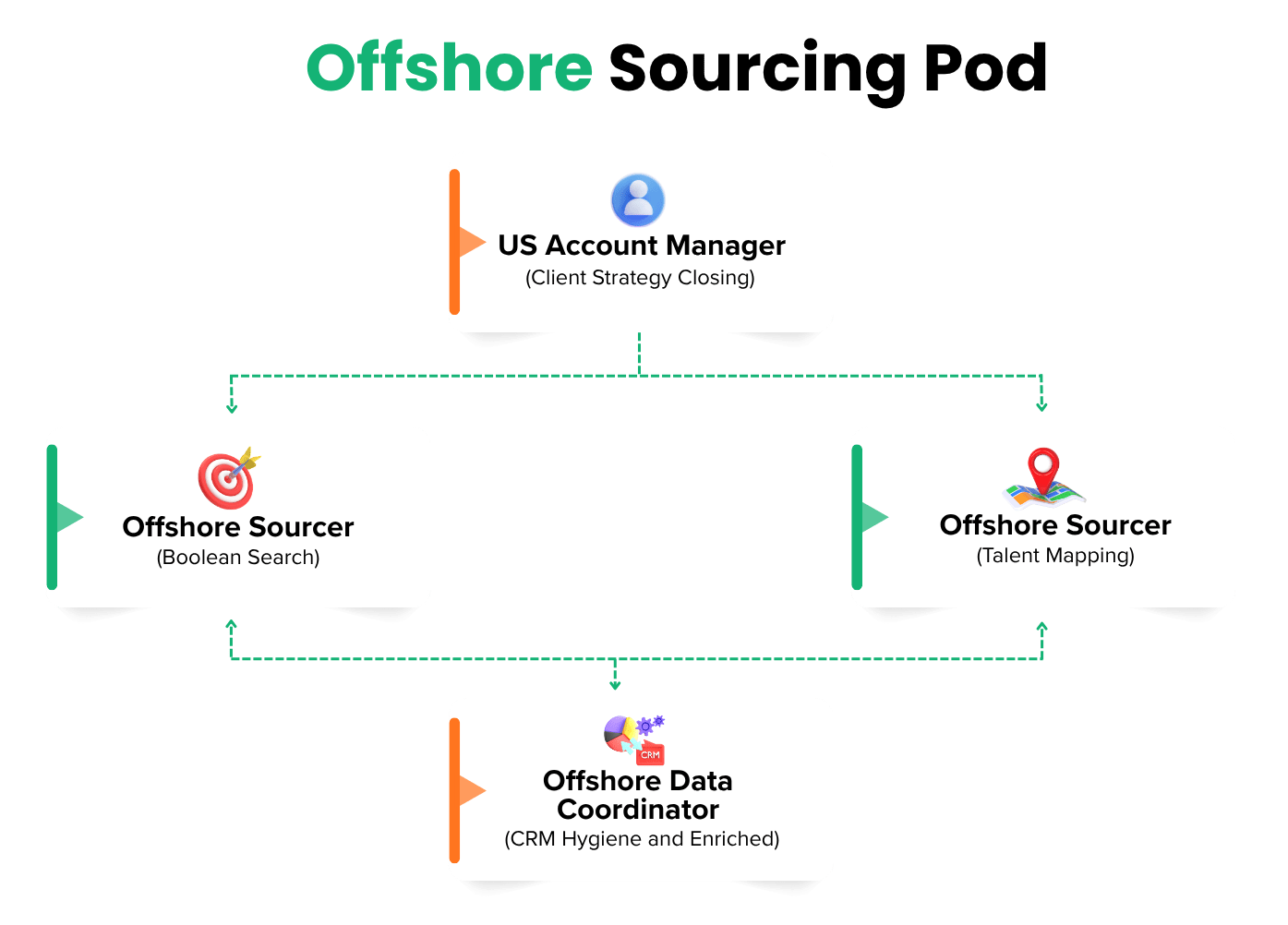
Traditional agencies run on individual ownership, but pods run on shared throughput. Instead of ‘my candidates vs your candidates,’ the pod is measured on one thing only, qualified candidates moving to the interview stage.
The US Account Manager
This role stays US-based for a reason. Not just due to time zones, there’s more context to it. They’re the ones talking to hiring managers, translating job descriptions into hiring, and handling the negotiation and positioning.
In a well-run pod, they stop doing sourcing altogether. That alone changes everything.
The Offshore Sourcing Specialists: The Outbound Engine
Now here’s where you build volume. These people spend their day doing one thing extremely well, i.e, mapping talent. It is very different from ‘searching LinkedIn casually.’ It is an actual structured sourcing using Boolean logic, GitHub traces, tech stacks, competitor mapping, and network adjacency. They build depth in the lists.
The Offshore Data Coordinator: Guarding Database Purity
People don’t specifically give this role as much credit as it deserves. Most ATS systems degrade over time. SIA research has repeatedly highlighted CRM/data decay as the main hidden cost in recruitment operations.
This role prevents that. Clean data, verified contacts, structured profiles; boring work, but it keeps everything else from collapsing.
How Podsourcing Builds Targeted Candidate Lists
Let’s walk through a real workflow.
Step 1: Translating Client Intake into Personas
The US lead turns a vague JD into something usable:
- actual stack
- competitor targets
- cultural signals
- deal breakers
This is where most recruiting processes already start to win or lose.
Step 2: Advanced Boolean Search Execution
Now the offshore team goes deep. They put in structured queries like:
(“Staff Engineer” OR “Principal Engineer”) AND (Python OR Go) AND (AWS OR GCP)
According to multiple sourcing benchmarks shared by ATS providers, structured search systems like this can reduce irrelevant candidate noise by 40–60% compared to manual sourcing.
Step 3: Data Enrichment and Validation
Once candidates are identified, the data gets cleaned, verified, and standardized. ASA-aligned staffing operations consistently emphasize one thing here: data integrity directly impacts fill speed.
Bad data = slow outreach = lost candidates
Simple equation with a painful reality.
Fixing the Flaws: How to Keep Offshore Teams on Track
This model works, but only if you don’t romanticize it. It breaks fast without feedback loops.
The 48-Hour Calibration Loop
The biggest reason offshore sourcing fails is a lack of feedback. An offshore sourcer might spend an entire week building a list, only for the US recruiter to look at it and say, ‘None of these people are a fit.’
To prevent these, implement a strict 48-hour calibration loop. When a new search launches, the offshore sourcer delivers a mini-batch of just 15 to 20 profiles within the first two days. The US recruiter reviews them immediately, providing specific notes like, ‘Candidate A is perfect. Candidate B has the right skills, but their current company size is too small.’ This quick feedback loop locks in calibration early and makes sure the pod spends the rest of the week running in the exact right direction.
The Asynchronous Advantage
One of the coolest parts of an offshore pod model is utilizing time-zone differences to create a 24-hour business cycle. When your US team logs off at 5:00 PM in Austin or San Francisco, your offshore pod is just starting their day across the world.
While your local competitors are asleep, your offshore engine is busy mapping the market, cleaning data, and queuing up personalized outreach messages. Your US headhunters wake up every single morning to a fresh batch of warm candidate replies, updated records, and scheduled interviews. You are quite literally outworking your competition while you sleep.
Enforcing Strict CRM Hygiene
An agency’s database is its most valuable asset, but only if the data is clean. Left unmanaged, an ATS becomes a digital graveyard of broken links and duplicate profiles.
Your offshore data coordinator must enforce strict, daily data standards. Every candidate profile added to the system must follow an exact format of properly capitalized names, accurate current employers, functional contact information, and clear source tags.
This consistent attention to detail keeps your system running smoothly, allowing anyone on your team to search your internal database months later and find perfect candidates easily.
The Dollars and Cents Offshore Teams on Track
Now, the part leadership actually cares about.
Cost Comparison
A mid-level US sourcer can easily cost $70K–$90K+ annually once you factor in overhead.
For that exact same financial investment, you can fund an entire, multi-person offshore sourcing pod. Instead of gaining the output of one local employee who is vulnerable to distractions and administrative fatigue, you gain a whole infrastructure unit dedicated solely to outbound delivery.
Reducing Time-to-Fill by 40%
When your data gathering is handled by a dedicated offshore pod, your local team can focus on candidate engagement. Because they aren’t bogged down by data entry, they can manage double the volume of candidate phone screens every week.
This operational velocity directly impacts your bottom-line metrics. Even a 20–40% reduction in time-to-fill (a range commonly reported across staffing optimization case studies) has a direct impact on revenue timing and cash flow cycles. And in agency business, timing is everything.
De-risking Scale With Done-for-You Infrastructure
Every agency owner worries about scaling too fast and getting stuck with overhead during sudden market shifts. An offshore pod model gives you the flexibility to expand delivery capacity without committing to additional domestic headcount.
That’s why many growing firms partner with BPO Wizard. Instead of spending months building and managing an offshore team from scratch, you get access to fully trained sourcing pods that handle talent mapping, list building, and CRM hygiene. And in this time, your recruiters can focus on conversations, placements, and revenue.
Bottom Line
The strategies of treating DEI as an extra or a defensive compliance measure is long outdated. An inclusive hiring strategy is now a high-performance requirement for any organization that intends to outpace the market. Most organizations fail in their DEI goals because they have the right intentions but the wrong mechanics. They rely on outdated systems that are accidentally designed for sameness. Success belongs to the leaders who treat inclusive talent acquisition with the same structural rigor as their digital infrastructure.
This is where a strategic design partner changes the trajectory. BPO W. helps businesses bridge the gap between DEI promises and hiring reality by hard-coding equity into the recruitment ecosystem. We help you eliminate bias, identify hidden talent in global hubs, and build cognitively diverse teams. Don’t let DEI debt take a toll on your innovation. Book a call to transform your recruitment function into a strategic engine that powers your growth for 2026.
FAQs:
A 360-degree recruiter manages every stage of the hiring process, from business development and sourcing to interviewing and closing candidates. In a pod-based model, those responsibilities are divided among specialists. It improves efficiency and collaboration.
An offshore sourcing team can support candidate sourcing, talent mapping, boolean search, LinkedIn Recruiter searches, database enrichment, CRM and ATS management, contact verification and candidate list building
This allows recruiters to spend more time engaging candidates and clients.
Recruiters often spend hours every week on sourcing, data entry, and CRM maintenance. By assigning these tasks to a dedicated offshore pod, recruiters can focus on higher-value activities like interviewing, relationship building, and closing placements.
Implementation depends on the provider, but many agencies can integrate a sourcing pod within a few weeks. With the right onboarding process, pods can quickly adapt to existing workflows, ATS platforms, and recruiting strategies.