

Table of Contents
From candidates’ expectations, AI tools, and hybrid teams to employers having pressure to hire faster and better candidates, 2025 has been a rollercoaster ride for recruitment trends. 2026 looks even more promising.

With that challenge in mind, here’s a closer look at the top recruiting trends for 2026 and how you can approach them with new energy.
Current State of Recruitment
Having an idea of the current state of recruitment would put the future into a better perspective.
- Talent shortages remain the main challenge across industries, particularly in tech and healthcare.
- Candidate drop-off rates are rising. According to SHRM, nearly 60% of job seekers abandon applications due to long or unclear processes.
- Recruiters are on their toes. They are expected to deliver results with fewer resources, thanks to slowed hiring or uncertain growth strategies.
- Tech adoption is increasing every day. Applicant Tracking Systems (ATS), CRM platforms, sourcing tools, and generative AI are no longer optional.
So one thing is clear from all of this: recruiters have to survive in a market that isn’t ideally crafted for them, and things can go either way.
Key Trends Shaping Recruitment in 2026
2026 will be a year full of trends that will greatly shape recruitment. Here are a few of what we have shortlisted.
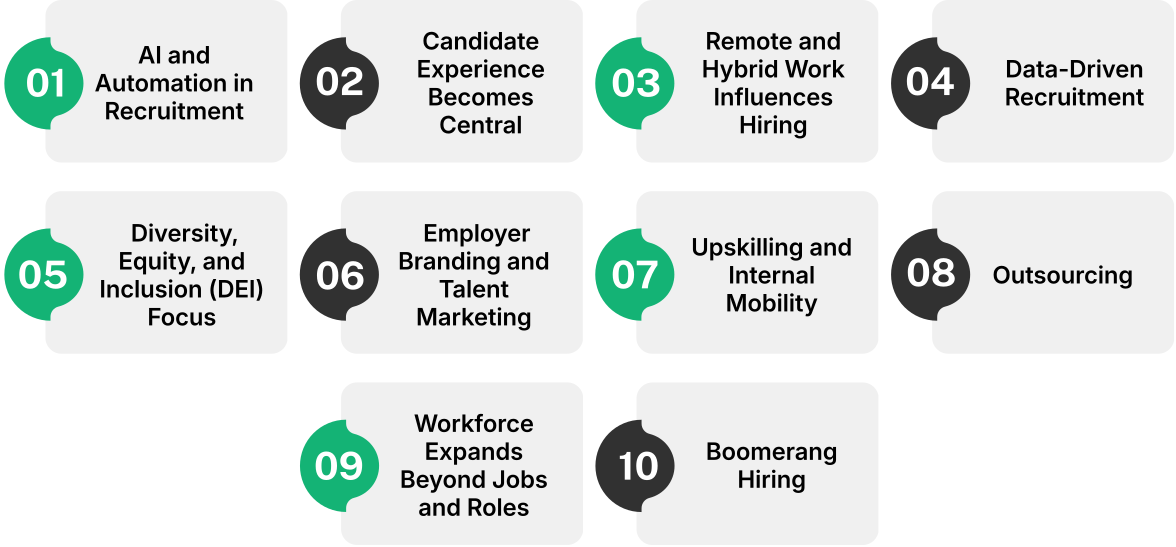
Trend 1: AI and Automation in Recruitment
AI in recruitment and where to avoid it is not a new thing now. But what’s changing in 2026 is that AI will now be used for decision-making, too, rather than just task automation. AI tools will help predict:
- If the candidate would accept an offer
- The time-to-fill for specific roles
- Which sourcing channels bring the best applicants
- If the candidate has a chance of high retention
So basically, AI will become an assistant in all decisions, and it will reduce the time to hire by a further 30 to 50%. (reccopilot)
Trend 2: Candidate Experience Becomes Central
“According to IBM, candidates are 38% more likely to accept a job offer when they’ve had a positive experience.”
What we have seen so far is that candidate experience matters, but it is less treated as a top priority. In 2026 and the coming years, recruiters are using tools that:
- Provide personalized prep guides before interviews
- Offer real-time application status updates
- Send automated but human-sounding and personalised emails
Another important shift is that candidates today want feedback, even when they don’t get selected. Companies offering rejection feedback, even short, structured notes, are getting higher employer brand scores.
Trend 3: Remote and Hybrid Work Influences Hiring
Remote work didn’t stop after the COVID pandemic. It has been increasing since, and it is expected to grow further.
It has influenced hiring decisions in many ways:
- Global Hybrid Teams. Larger talent pools mean better matches and more diverse teams.
- Compensation strategies are shifting. Location-based pay is being replaced by role-based or capability-based pay.
- Culture fit is becoming culture add. Remote hiring pushes employers to focus on values alignment rather than imitating the same personalities.
But still, there are cases where remote and hybrid teams don’t work. To assess that, companies are using trial projects or scenario-based assignments to see if they are compatible with real-world performance.
Trend 4: Data-Driven Recruitment
No more hiring based on gut feeling. Now, with predictive analysis, there are clearly defined metrics on which candidates are evaluated. The top metrics are:
- Time-to-productivity
- Source effectiveness
- Candidate conversion rates
- Retention probability
Trend 5: Diversity, Equity, and Inclusion (DEI) Focus
DEI has always mattered for companies, but now the Gen Z influence is clear. It has enabled DEI to focus its branding strategy and establish a performance metric.
So, what’s changing in 2026?
- Companies are going for skills-first hiring, which reduces degree bias.
- Structured interviews and scoring on different parameters are becoming a new standard.
- ATS systems have tools that detect biases and identify any risky patterns.
- Now teams track DEI impact on innovation and performance, not just representation.
Trend 6: Employer Branding and Talent Marketing
A recent survey from Glassdoor revealed that 75% of candidates consider a company’s employer brand before applying for the job. (TalentPool)
You could say that half of recruitment is hiring, and the other half is marketing. That is why employers need to work on their:
- Behind-the-scenes culture posts
- Employee-generated content
- Social-friendly hiring campaigns
- Storytelling in the form of employees’ journeys or company insights
- Strong career pages that lead to conversions
Now talent marketing is more about showcasing your culture to build trust. Merely big claims won’t perform in 2026.
Trend 7: Upskilling and Internal Mobility
2026 is going to be all about building your internal resources instead of having more and training them from scratch. So what led to this change?
- Hiring costs will continue to increase
- Skills are evolving faster than job descriptions
- Younger employees want growth, not position stability
- Companies want to retain institutional knowledge
For these things, what companies are doing now is including programs like skill-based learning platforms, internal job boards, and career pathing tools.
Trend 8: Outsourcing
Restructuring used to mean downsizing. Today, it means right-sizing, and outsourcing is at the center of that shift. Companies are realizing they don’t need large, bloated in-house teams. Instead, they can have outsourcing partners for sourcing, screening, recruitment operations, employer branding, and even full-cycle hiring.
What’s changed now is why they’re outsourcing. There are many other reasons for it than just cutting costs.
- Hyper efficiency: Outsourcing teams work fast and smart using advanced tools and well-trained recruiters.
- Tech Stack: The recruitment outsourcing agencies have a tech stack worth thousands of dollars, which prevents investment on the recruiters’ end.
- Scalability: Companies can quickly increase or decrease hiring without extra long-term costs.
- Speed: Outsourcing helps fill roles much faster, especially tough or high-volume ones.
- Expertise: External teams bring strong experience, proven methods, and market insights that in-house teams may not have.
Trend 9: Workforce Expands Beyond Jobs and Roles
AIHR regarded this as one of the key trends for 2026. The traditional “job + role + title” structure is fading. The future workforce is becoming more skills-based, fluid, and borderless.
“The companies that value skill-based hiring are 57% more likely to anticipate change and stay ahead of the trends (Deloitte)”
The main drivers of this trend are:
- Skill-first work: Teams are now built around skills, not job titles.
- Talent marketplaces: People can pick short projects or gigs inside and outside their company.
- Fractional experts: More professionals prefer part-time or project-based work instead of full-time jobs.
- Global teams: Remote work means companies can hire the best talent from anywhere in the world.
Trend 10: Boomerang Hiring
Companies in the retail and finance sectors have begun adopting this trend. They are rehiring laid-off talent, especially managers with institutional knowledge, because it’s faster, cheaper, and less chaotic than onboarding newbies.
With layoffs still being so frequent, this ‘boomerang hiring’ trend isn’t a temporary fix. This trend is shaping up to be a strategic approach for 2026.
For recruiters, it means warm talent pools, faster fills, and higher-quality hires without the sourcing headache.
Best Recruiting Niche in the US for 2026
Looking ahead to 2026, these are some of the fastest-growing recruiting niches in the U.S. These are the areas where demand is high, and opportunities for placements are growing fast.
- School-Based Mental Health: Schools need more counselors and psychologists as student mental health demands grow. There’s a lot of hiring happening, and recruiters can really make an impact here.
- Clean Energy: Solar, wind, EV infrastructure, and green manufacturing are exploding across the U.S. Companies can’t find enough engineers, technicians, and project staff, making clean energy one of the fastest-growing and most rewarding recruiting areas.
- Defense: Defense roles, from cybersecurity to aerospace, are in high demand with plenty of federal funding behind them. It’s steady, specialized work for recruiters who know the space.
- Cold Storage and Food Chain: The food supply chain is expanding, and companies need people to run warehouses, logistics, and temperature-controlled facilities. It’s an overlooked niche with steady demand and less competition among recruiters.
- Veterinary and Pet Health: Pets are everywhere, and clinics are short on staff. Vets, techs, and support roles are in demand, making it a reliable niche for recruiters.
Predictions for the Next 5 Years
The recruitment industry, as seen by its current growth, has so much potential to expand, whether it is in the next five years or five days. Some predictions from the recruitment based on the trends and how it is seen to shape the future are:
- Companies will build talent pools of pre-evaluated candidates ready for short-term or long-term roles.
- By 2030, AI will be used in almost all recruitment processes (about 94%), with human-like language tools adopted by 81% of companies (Secondtalent)
- Recruiters will become more of advisors than process managers.
- AI will handle 60 to 70% of sourcing and screening.
- Most interviews will include tasks or work samples.
- Employer branding will be as important as customer branding.
Conclusion
The ultimate paradox in the world of recruitment for quite some time now is that candidates often feel there aren’t enough opportunities, while employers struggle to find the right talent to fill their roles.
But there is one thing they all agree on, which is that the recruitment world is changing every second.
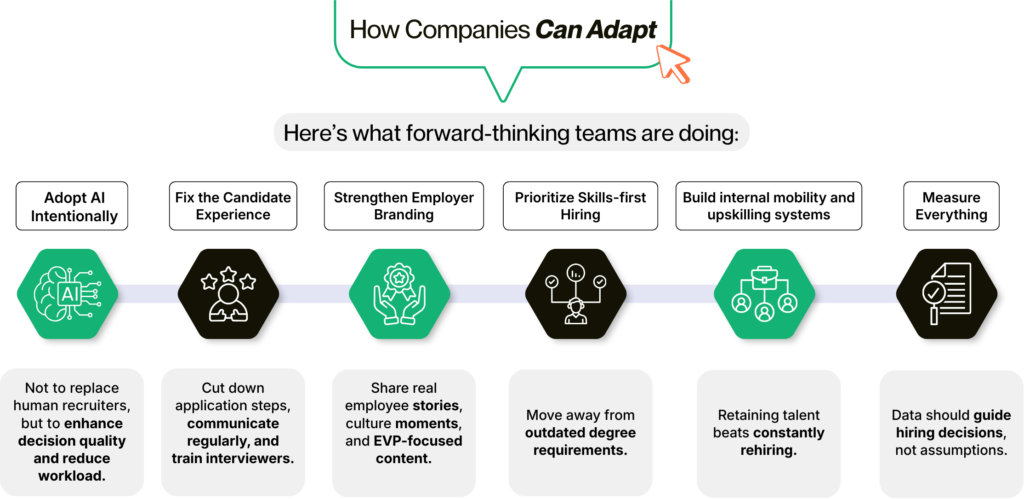
2026 will be the year when doing the bare minimum or basics won’t help. The change will begin with a change of mindsets, then choosing the right tools, prioritising people, and finally building a process that reflects the modern workforce
So have a critical look at your hiring process. See what needs to be changed and how AI, skills-first hiring, and giving your people room to grow can make a difference. Let us know what more is coming for 2026.
Frequently Asked Questions
The top trends include AI-driven hiring, predictive analytics, skills-first recruitment, outsourcing, stronger employer branding, remote and hybrid work models, and a growing focus on candidate experience.
AI will move beyond automation and support real decision-making—predicting offer acceptance, time-to-fill, retention likelihood, and candidate fit. It will help reduce time-to-hire by 50%.
Skills-first hiring focuses on what candidates can do, not their job titles or degrees. Teams are built around capabilities, which increases internal mobility and talent becomes more flexible.
No. AI will take over repetitive tasks and provide insights, but recruiters will shift into strategic roles like advising hiring managers, improving candidate relationships, and shaping talent strategies.