
Table of Contents
In the 2026 US market, abandoned executive profiles are a sign of operational risk, and they are quietly costing you leads.
For years, many leaders viewed LinkedIn as a digital filing cabinet, a place to store a resume “just in case.” But the market has moved on. Today, LinkedIn is the primary location for validation. It is where recruiters verify your trajectory, buyers assess your bench strength, and peers decide if you are a bridge or a dead end. In the words of seasoned professionals, LinkedIn is a gold mine.
When your profile is outdated, stagnant, or covered in corporate-speak, it actively erodes your authority. A quiet profile is a signal of irrelevance, especially in a world where decision-making has sped up.
Why LinkedIn Visibility is Critical for Executives in 2026
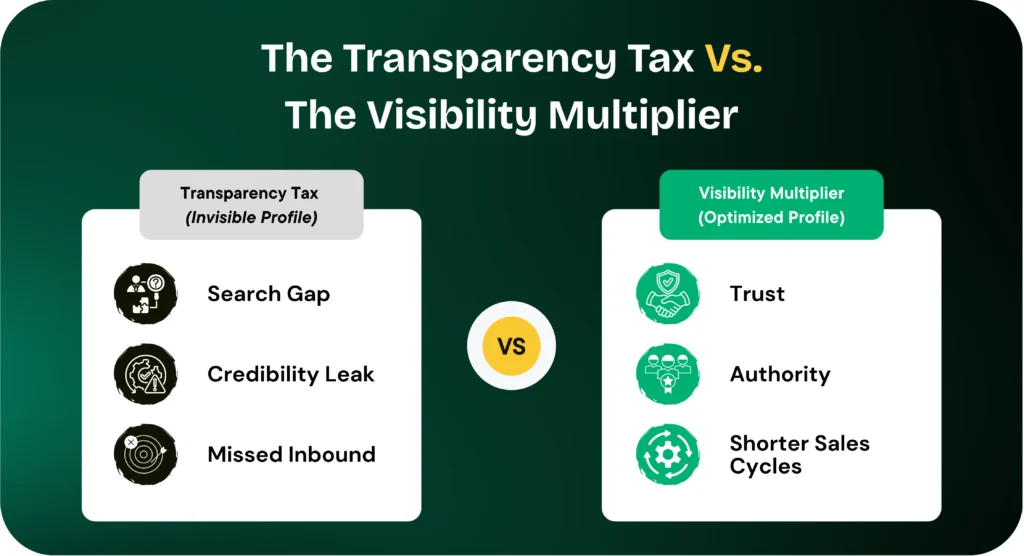
The shift we’ve seen this early in the year is clear. Perfect brochures no longer move buyers and partners. The people behind the brand move them. If your executive presence isn’t optimized, you are paying a transparency tax you can’t afford.
The Silent Cost of Inactive Profiles
Most executives don’t think an inactive profile is hurting them. They assume that if they aren’t looking, it doesn’t matter. That is a dangerous delusion. The cost of an inactive profile is found in what fails to happen.
- The Search Gap: LinkedIn functions as a massive, specialized search engine. If your profile isn’t optimized for 2026 keywords, you simply don’t exist in the queries that matter.
- The Credibility Leak: Clients and consultants perform a digital background check before the first discovery call. An outdated profile suggests a lack of current market engagement.
- The Google Factor: For most executives, their LinkedIn profile is the #1 or #2 result on Google for their name. If that landing page is weak, your first impression is already tainted.
How Executive Presence Drives Trust and Leads
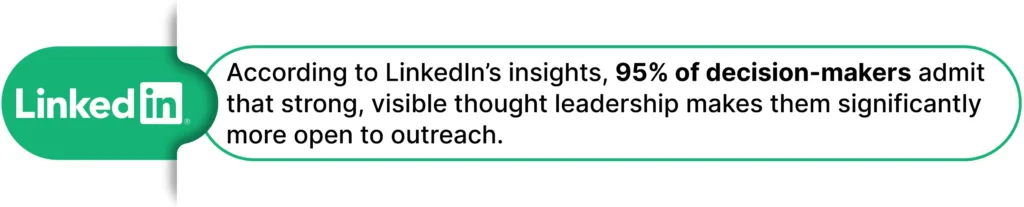
Trust is the only currency that hasn’t been devalued by AI-generated noise. In fact, LinkedIn’s data shows that 75% of B2B decision-makers consider thought leadership content a more trustworthy way to assess a leader’s capabilities than any marketing material.
For the modern executive, especially in the US, your presence does the heavy lifting before you ever open your mouth. It builds authority without the hard sell and creates familiarity before the first calendar invite is sent.
The Optimization Blueprint: Turning a Profile into a Strategic Asset
If you want to move from filling a seat to staging influence, you need a structural reset of your digital footprint. The focus is on speed-to-capability, rather than on vanity.
The Core Pillars of the 2026 Executive Profile
Keywords: The Intersection of CEO Branding and Search
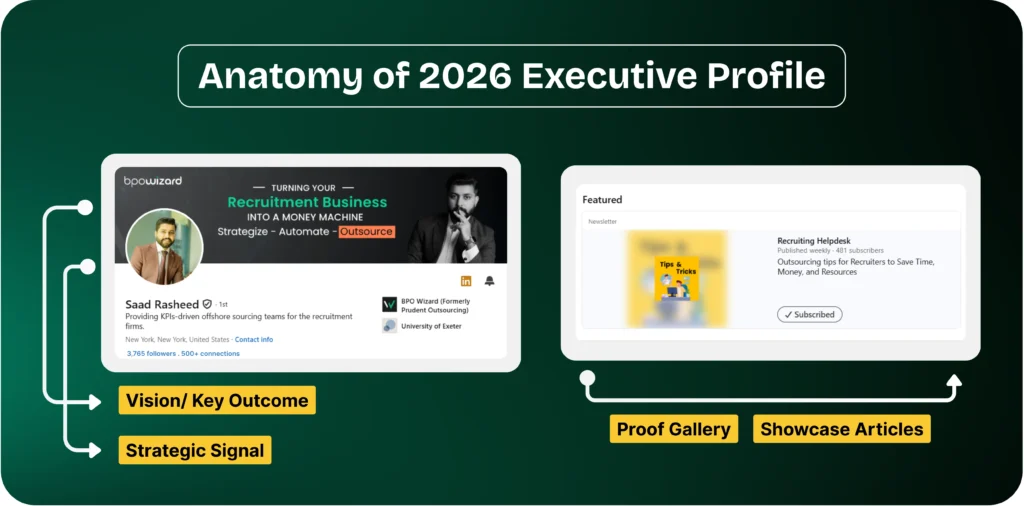
LinkedIn is a search engine, and your profile needs to be indexed correctly. Strategic keyword placement, integrating role-specific terms, industry-specific pain points, and strategic themes, ensures you surface in the right rooms. Your profile should support your ideas, and your ideas should reinforce your profile. This is how you strengthen your E-E-A-T (Experience, Expertise, Authoritativeness, and Trustworthiness) signals for both human readers and algorithm crawlers.
Thought Leadership: Social Selling Without the "Cringe"
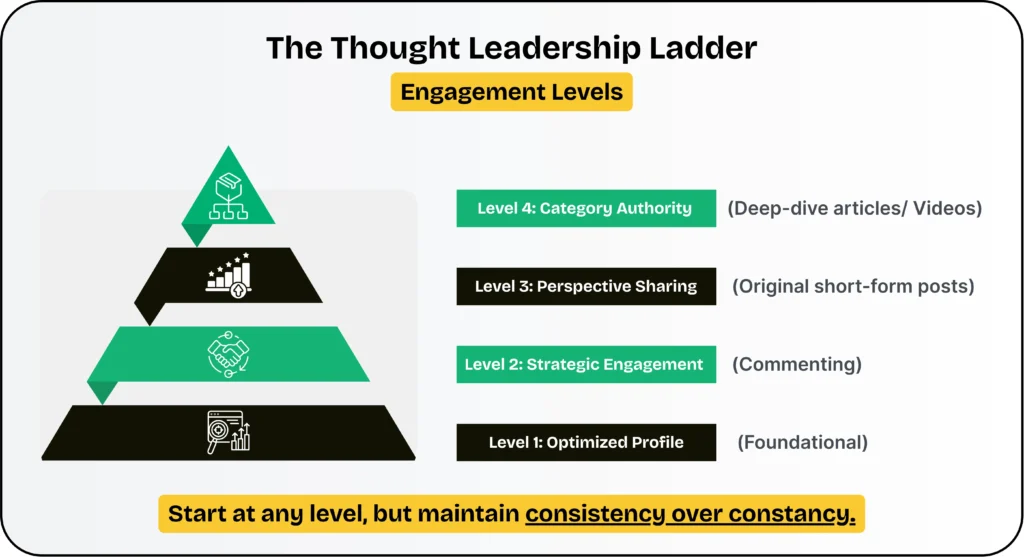
The #1 reason executives avoid LinkedIn is the fear of sounding like a content creator. But now, the most effective social selling is quiet, data-driven, and perspective-heavy.
Perspective Over Promotion: The Role of Thought Leadership
Thought leadership focuses on sharing valuable insights at a consistent pace. Being regular in your practice makes a real difference. More importantly, when you share insights drawn from real-world experience, you allow potential partners to self-qualify. They aren’t just buying your service. They are buying into your way of thinking.
Effective executive social selling looks like:
- Sharing the Why: Providing the rationale behind a pivot or a strategy.
- Thoughtful Curation: Commenting on industry shifts with a unique angle.
- Strategic Buffering: Using your presence to absorb market shocks by projecting calm, expert authority.
The #1 reason executives avoid LinkedIn is the fear of sounding like a content creator. But now, the most effective social selling is quiet, data-driven, and perspective-heavy.
Perspective Over Promotion: The Role of Thought Leadership
Thought leadership focuses on sharing valuable insights at a consistent pace. Being regular in your practice makes a real difference. More importantly, when you share insights drawn from real-world experience, you allow potential partners to self-qualify. They aren’t just buying your service. They are buying into your way of thinking.
Effective executive social selling looks like:
- Sharing the Why: Providing the rationale behind a pivot or a strategy.
- Thoughtful Curation: Commenting on industry shifts with a unique angle.
- Strategic Buffering: Using your presence to absorb market shocks by projecting calm, expert authority.
The Audit: How to Measure What Matters
Reframing the brand visibility audit as a pulse check rather than a quarterly burden flips the script. The market is continuously changing in the United States with new trends, approaches, and techniques surfacing every other day. If you haven’t touched your profile in six months, you are likely misaligned with the current market.
Five Steps to a 2026 Visibility Reset
- Eliminate the Legacy Language: Remove roles or achievements that no longer serve your current objectives.
- Clarify the Headline: Does it tell a stranger exactly why they should listen to you in under 5 seconds?
- Audit the “About” Story: Move away from the brochure tone. Speak like a human.
- Check for Search Holes: Are you missing the sections (Featured, Skills, Volunteering) that give the algorithm the data it needs to rank you?
- Review the Feed: Does your recent activity reflect a leader who is engaged, or a leader who is checked out?
Success Metrics that Actually Matter
Forget Likes. In the executive world, we track:
- Inbound Volume: Are relevant people reaching out to you?
- Search Appearances: Is your name surfacing in the right industry queries?
- The Feedback Loop: Are people mentioning your recent posts during high-stakes meetings?
The Friction Point: Common Executive Missteps
Even with a strategic mindset, many leaders fall into “legacy traps” that sabotage their visibility. These friction points slow down your professional momentum and should not be taken lightly.
The Executive Pitfall Summary
Why Average is Your Biggest Competitor
Identifying the gap is the first step toward closing it. If you recognize your profile in any of the following categories, you are likely leaving influence revenue on the table.
1. The Time Capsule: Outdated or Incomplete Profiles
Present executive careers move at the speed of the market, yet many profiles are still anchored in 2022. When your profile fails to reflect your current scope of leadership, it creates a value gap for the viewer. A recruiter or partner looking for a 2026-scale leader will be confused by a profile that still talks about 2020-scale problems.
2. The Sound of Silence: Lack of Engagement
In the current algorithm, inactivity is interpreted as irrelevance. Silence sends a message that you are either overwhelmed, technically disconnected, or have nothing left to contribute to the conversation. Strategic engagement, commenting on a peer’s insight or sharing a brief reflection on a market shift, signals that you are still in the arena.
3. The Tone Mismatch: Too Corporate or Impersonal
Many executives hide behind their organization, handling tasks from behind the curtains. While professional, it is inherently impersonal. In an era where AI can generate perfect corporate prose, human authenticity has become a premium asset. Profiles written like a cold annual report fail to build the familiarity required for modern social selling. People want to follow a leader with a perspective and the energy to bring change.
4. The Network Vacuum: Passive Connection Building
The final mistake is treating LinkedIn as a one-way broadcast. The most successful leaders use their visibility to build a strategic buffer of connections before they need them. If you only engage when you have an ask, you’ve already lost the trust game.
Final Thoughts: The Cost of Inactivity
The period of the optional LinkedIn profile is officially in the rearview mirror. In 2026, your digital brand is either a multiplier for your business or a drag on your results.
The silent cost of being invisible is the opportunity you never knew existed. By shifting your mindset from “social media” to “strategic capacity,” you transform your profile from a static resume into a high-performance engine for trust and revenue.
Frequently Asked Questions
Executive branding acts as a trust multiplier in the B2B sales cycle. In 2026, buyers prioritize “People-to-People” validation over corporate marketing.
The most effective keywords for a CEO should focus on outcomes rather than just titles, such as:
- Role-specific terms: e.g., “Board Advisor” or “Fractional COO.”
- Industry pain points: e.g., “Digital Transformation” or “Operational Efficiency.”
- Strategic themes: e.g., “AI-Driven Growth” or “Sustainable Supply Chain.”
In 2026, the LinkedIn algorithm prioritizes consistency over constancy. Posting 1–2 times per week with high-value, perspective-driven content is more effective than daily updates.
A LinkedIn brand visibility audit is a strategic review of an executive’s digital footprint to ensure it aligns with current business goals. An audit includes:
- Keyword Alignment.
- EEAT Signal Check.
- Media Refresh.