

Table of Contents
A retained search partner in Midtown pulls up her CRM three days before a board presentation and finds that 40% of the contacts in her “qualified candidates” segment either bounce, belong to someone who changed jobs eighteen months ago, or point to a company that no longer exists. She’s not short on candidates. She’s short on current candidates, and the difference is costing her the one thing a retained mandate can’t survive: time.
This is the quiet failure mode inside most Manhattan and Tri-State search firms. Databases built over a decade of headhunting look like assets, but without constant enrichment and validation, they decay in place. Email churn, job-hopping, and LinkedIn profile drift erode a candidate list faster than any recruiter can manually rebuild it, especially one who’s also running twelve live searches.
The Fix:
The firms that solve this don’t hire more recruiters to do data entry. They outsource database enrichment for executive search firms to a team that treats it as infrastructure, not a one-time cleanup. But handing candidate and client data to an outside team raises a legitimate question for any search partner in the US, UK, or Australia: how do you do this without compromising the confidentiality a retained mandate depends on?
Why NY Search Firms Can't Keep Databases Clean In-House?
A boutique agency or executive headhunter running 15–20 open retained searches at once has recruiters spending their billable hours on client calls, candidate screens, and slate presentations, not deduplicating spreadsheets or re-verifying phone numbers.
In finance and tech-heavy markets like Wall Street and Midtown, this problem compounds. Candidate turnover in those sectors is faster than in slower-moving industries like manufacturing or healthcare administration, which means a CRM segment that was accurate in Q1 can be a quarter out of date by Q3.
The mistake most agencies make here is conflating two very different services. A VA can update a spreadsheet field, but a proper enrichment partner runs structured validation against bounce databases, cross-verifies against LinkedIn Recruiter, and re-tags records for Boolean searchability, work that requires sourcing background.
Firms that outsource to the wrong type of vendor end up with a database that’s technically “touched” but still functionally stale.
What "Safe" Outsourcing Actually Means
Database enrichment outsourcing is “safe” when three conditions are met:
- the vendor operates under a signed NDA and documented data-security standard
- they follow strict CRM field-mapping protocols before any bulk upload
- there’s a clear, auditable chain of custody for every record containing candidate or client PII.
Cheap enrichment services skip all three. Here’s what each one actually requires.
Data Security
Look for offshore sourcing support backed by NDAs written for the specific engagement rather than a generic freelancer marketplace agreement. SOC 2-aligned practices (access controls, encrypted storage, restricted data retention windows) are the baseline, not a bonus feature. If a vendor can’t explain where data is stored or who has access to it, that’s disqualifying, not a detail to negotiate later.
CRM Hygiene Protocols
Before any bulk upload touches a live system, field mapping needs to be verified against the specific CRM or ATS in use; Bullhorn, Loxo, and Crelate each structure custom fields differently. A vendor who uploads without confirming field mapping will silently corrupt segmentation, tagging, and search history that took years to build.
Chain of Custody
This is the question search partners skip most often: who, specifically, touches a candidate’s PII, where does it live during processing, and when is it purged from the vendor’s systems after the project closes? A retained search firm handling confidential client mandates needs a documented answer here.
If you’re weighing whether to build this in-house or hand it off, it helps to see the actual workflow first: (see how CRM hygiene and candidate pipelining work together in practice.)
The Enrichment & Validation Workflow (Step-by-Step)
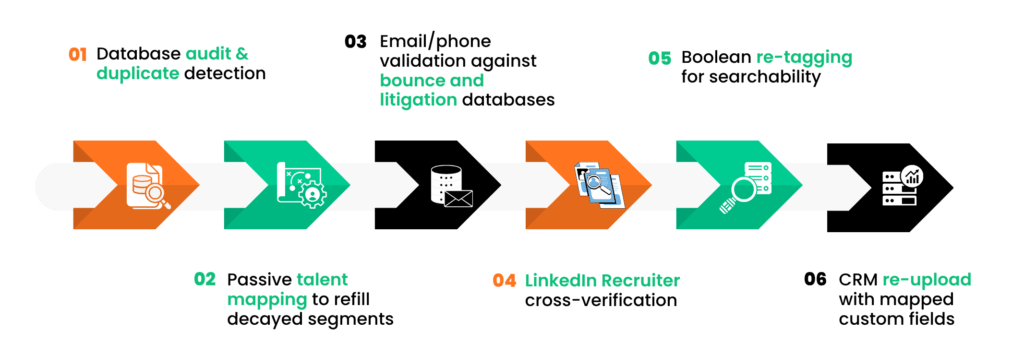
How does database enrichment and validation work for executive search firms? The process runs in six stages, moving from audit to re-upload, with validation checkpoints at each step to protect data integrity.
- Database audit & duplicate detection: Every record is scanned for duplicates, incomplete fields, and segments flagged for decay based on last-verified date.
- Passive talent mapping to refill decayed segments: Where records are too stale to salvage, the team runs passive talent mapping to rebuild the segment with current, sourced candidates rather than patching outdated ones.
- Email/phone validation against bounce and litigation databases: Contact data is checked against active bounce lists and compliance databases before it re-enters outreach sequences.
- LinkedIn Recruiter cross-verification: Current role, company, and location are cross-checked against LinkedIn Recruiter to catch job changes the CRM hasn’t recorded.
- Boolean re-tagging for searchability: Records are re-tagged using structured Boolean logic so the sourcing pod can retrieve candidates by skill, title, and sector without manual filtering.
- CRM re-upload with mapped custom fields: Cleaned records go back into the ATS/CRM with field mapping verified in advance, preserving existing segmentation and search history.
This workflow is what separates enrichment from a generic data-cleaning pass. It’s built around list building and candidate pipelining needs specific to search firms.
What This Looks Like for a Manhattan Retained Search Firm
Picture a 12-person retained search boutique in Midtown running financial services mandates, CFO and controller-level placements for mid-market firms, in a market where Crain’s New York Business reports the city’s largest executive-recruiting firms grew their workforces by an average of 15% this year after a period of pandemic-era cutbacks. Their CRM holds roughly 18,000 candidate records built up over nine years, but a full third haven’t been touched since before the firm’s last office move.
Rather than pulling recruiters off live searches, the firm runs enrichment offshore, in parallel with active mandates. Over six weeks, the vendor works through the backlog in batches tied to the sectors the firm is actively sourcing in, so refreshed segments are usable almost immediately.
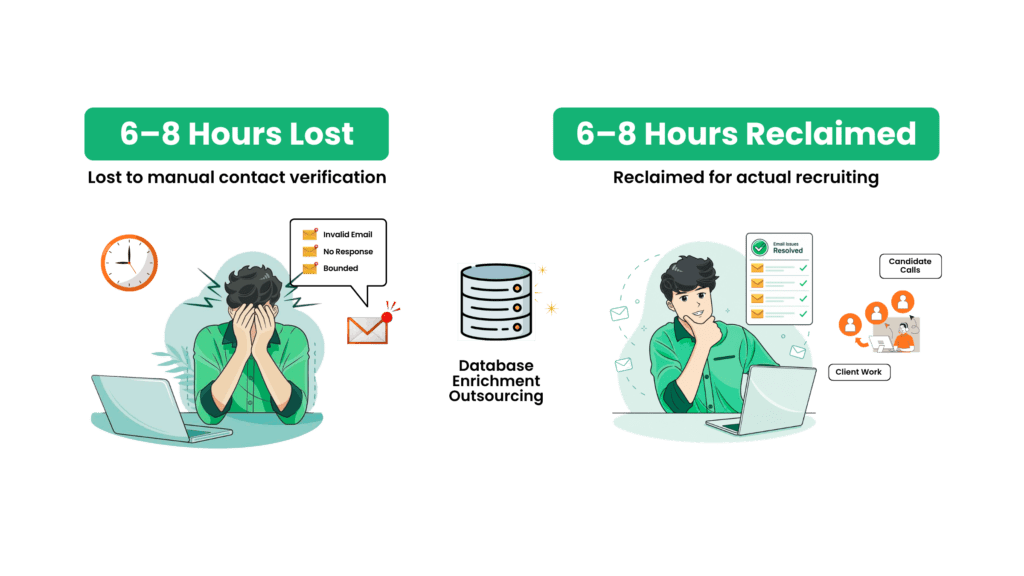
The reclaimed time is the real story. Recruiters who were spending roughly 6–8 hours a week manually verifying contact details get that time back for candidate calls and client-facing work. Search cycle time on live mandates shortens because outreach lists stop bouncing at the rate they were, fewer wasted sends, faster response cycles, tighter shortlists.
Does This Work the Same Way for UK, Australian, or Canadian Search Firms?
Yes. The core workflow doesn’t change by geography, but the compliance layer does. UK and EMEA-based search firms need enrichment vendors who handle candidate data in a way aligned with GDPR requirements, particularly around consent and retention periods. US-based firms operate under a different, generally less prescriptive set of data-handling norms, though client confidentiality expectations remain just as strict. Australian and Canadian firms sit closer to the UK model on data protection but with their own local nuances.
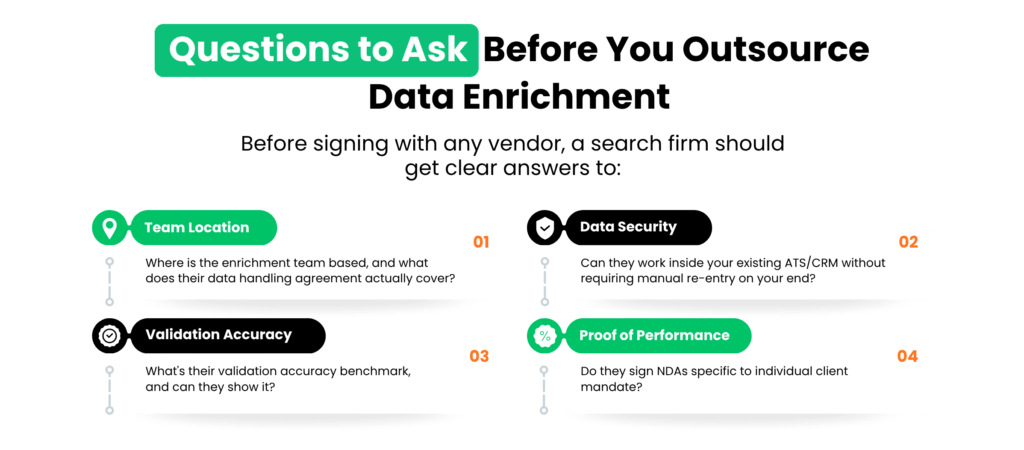
If a vendor hesitates on any of these, that hesitation is the answer.
Common Mistakes NY Firms Make When Outsourcing Database Enrichment
The most expensive mistake is treating enrichment as a one-off cleanup project instead of an ongoing pipeline function. A database enriched once and left alone starts decaying again immediately the value is in the recurring cadence..
The second is handing raw client mandate lists to generalist VA services with no sourcing background. These are the same lists containing confidential retained search client information, and a vendor without sourcing expertise doesn’t know what data actually matters to protect versus what’s routine. That distinction only comes from having done executive search sourcing work.
The Real ROI of Clean Data for Executive Search
Clean, enriched data is what determines whether a search cycle takes four weeks or eight. Faster search cycles, more accurate shortlists, and fewer bounced outreach emails on live retained mandates all trace back to the same root cause: whether the underlying database was current when the search started.
If your firm is still absorbing this cost internally, it’s worth seeing what a structured enrichment workflow looks like in practice before deciding whether to build it in-house or hand it off.
See how BPO Wizard runs database enrichment and validation for retained search firms
FAQs:
A: Database enrichment is the process of updating, validating, and expanding candidate records in a search firm’s CRM. It includes correcting outdated contact details, confirming current employer and title, and filling in missing data so the database stays usable for active sourcing rather than decaying into an unreliable archive.
A: It’s safe when the vendor operates under an engagement-specific NDA, follows documented data-security standards, and can account for exactly who accesses records and how long data is retained. It’s not safe when a firm hands data to a generalist freelancer marketplace with no formal data-handling agreement in place.
A: Timelines depend on database size and decay level, but a mid-sized firm with 15,000–20,000 records typically sees a full enrichment pass completed in four to six weeks when run in batches alongside live search work.
A: The core workflow is the same, but UK and EMEA firms need vendors who handle data in a way aligned with GDPR consent and retention rules, while US firms operate under different, generally less prescriptive, data-handling norms.