
Table of Contents
A few years ago, AI in recruitment felt like something reserved for tech conferences and futuristic slides. Today, around 87% of companies use AI at some point in their hiring process.
If recruitment used to be like searching for a needle in a haystack, AI has brought in a magnet. Specifically in Recruitment Process Outsourcing (RPO), where volume, speed, and accuracy are a few non-negotiables, technology is becoming the backbone.
But let’s slow down for a second. You might think that AI is replacing recruiters. No, it’s just tweaking (in a better way) how they work. And this change is what you need to understand.
What is the Role of AI in Recruitment Process Outsourcing?
The core of recruitment process outsourcing is that the companies outsource hiring so they can:
- Reduce time-to-hire
- Improve candidate quality
- Streamline operations
- Focus internal teams on strategy
For years, it was all done by systems, spreadsheets, and human effort. Then AI entered the picture. Instead of manually sorting resumes or rewriting job descriptions from scratch, AI now supports those tasks. This AI revolution didn’t happen overnight. Instead, RPO functions were automated one after another, and now we are here.
And as the saying goes, change doesn’t knock politely; it barrels in, rearranges the furniture, and leaves you standing in a room you barely recognize. That’s exactly what AI did to recruitment.
Generative AI for Job Descriptions and Candidate Outreach
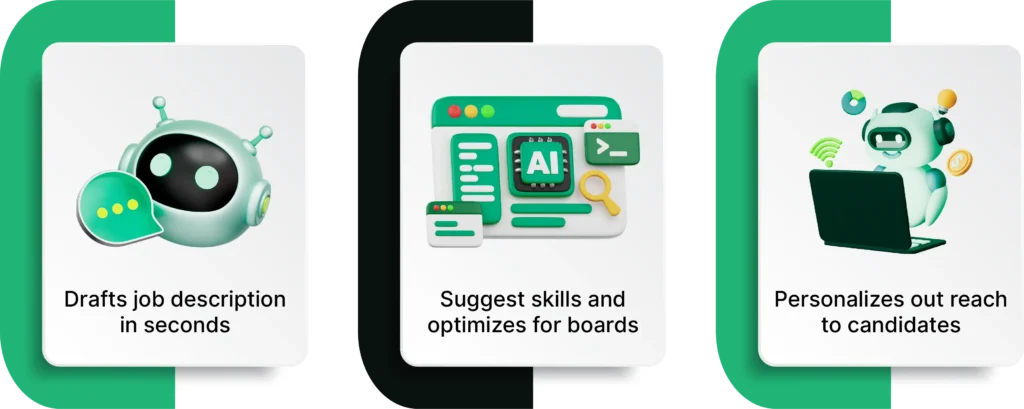
Let’s start with something practical. Writing job descriptions sounds simple until you have twenty open roles with different client expectations. Traditionally, recruiters copied templates and adjusted details manually. Now, 65% of the HR professionals in the US let generative AI handle it. It will:
- Draft job descriptions in seconds
- Suggest skill-based requirements
- Optimize content for job board visibility
- Adjust tone depending on the industry
But what makes it better for us is the consistency. AI ensures that every job description has structured data rather than random wording. It’s like having a skilled assistant who never gets tired of editing.
The same applies to candidate outreach. Instead of sending generic messages that feel automated, AI can generate personalized outreach based on the candidate experience, skill relevance, career history, and role alignment.
Personalization at this level used to feel impossible, and now AI has made it so easy. But still, it needs human review and refining because technology can be a support, not a replacement for human oversight.
AI in Sourcing, Screening, and Candidate Matching
If sourcing used to mean scrolling through databases and hoping keywords matched, then those days are ancient history now. AI-driven sourcing works differently.

Smart Search Beyond Keywords
Traditional systems matched exact phrases, but AI understands context. For example, a candidate who worked as a Digital Project Lead might still qualify for a Technical Project Manager. Even if the title isn’t the exact match, AI has given the flexibility to open talent pools that would otherwise stay hidden.
Resume Parsing and Automated Screening
AI tools can extract structured information from resumes:
- Skills
- Certifications
- Experience duration
- Career progression
Then they rank candidates based on job criteria. For an RPO team handling high-volume hiring, this will save hours (sometimes days) of manual review. Where you would spend hours screening 500 resumes one by one, you can start with a prioritized shortlist. It won’t reduce human judgment, but direct the effort in the right direction instead of hours of data cleanup.
Predictive Matching
Some advanced AI systems go even further. They can analyze historical hiring data to identify patterns like:
- Which profiles performed best
- Which skills predict long-term retention
- Which combinations improve team success
This turns hiring into something closer to data science. As the market becomes competitive, companies that rely purely on intuition often fall behind.
AI and Bias: A Catch-22?
Now that’s where things get interesting. One of the biggest promises of AI in recruitment is bias reduction. AI is very fair in such aspects where it will:
- Remove names and demographic markers during screening
- Focus purely on skills and qualifications
- Apply consistent scoring models
And in RPO, consistency matters because different recruiters may evaluate similar profiles.
But AI is not automatically unbiased. If historical hiring data reflects bias, the algorithm may learn from that pattern. So, before assuming AI solves bias, organizations must monitor it themselves.
You should have regular model audits and eventually always rely on human oversight for final decisions because no matter how much AI is there, it can never have the same moral compass as humans.
Ethical Considerations and Risks of AI in Hiring
As our trustee, Spiderman’s Uncle Ben once said, ‘With great power comes great responsibility.’
In the spirit of the original, we translate it to, ‘With great automation comes great responsibility and even greater monitoring dashboards.
AI and automation in recruitment are one of the top recruitment trends of 2026. It has become embedded in recruitment systems, and now ethical questions cannot be ignored.

Data Privacy
Candidate data is sensitive. So RPO providers must make sure they have:
- Secure data storage
- Clear consent policies
- Compliance with local regulations
As trust is built on protection.
Transparency
Candidates and clients deserve clarity. If AI is used in screening, they have the right to question how decisions are made or what factors influence ranking. Keeping these hidden will only increase suspicion. Keep things transparent from day one, as it increases your credibility and trustworthiness.
Avoiding Over-Automation
It’s tempting to automate everything. But hiring is more of a people matter, and too much automation will make it lose its essence. Fully automated decisions without human review will have risks of ignoring unconventional career paths and missing soft skills that data cannot measure.
So, Where Does This Leave Recruitment and RPO?
AI hasn’t turned recruitment upside down overnight. It’s been more like a slow kitchen upgrade. First, the microwave arrived, then the dishwasher, then it hit you that you’re cooking very differently than you used to.
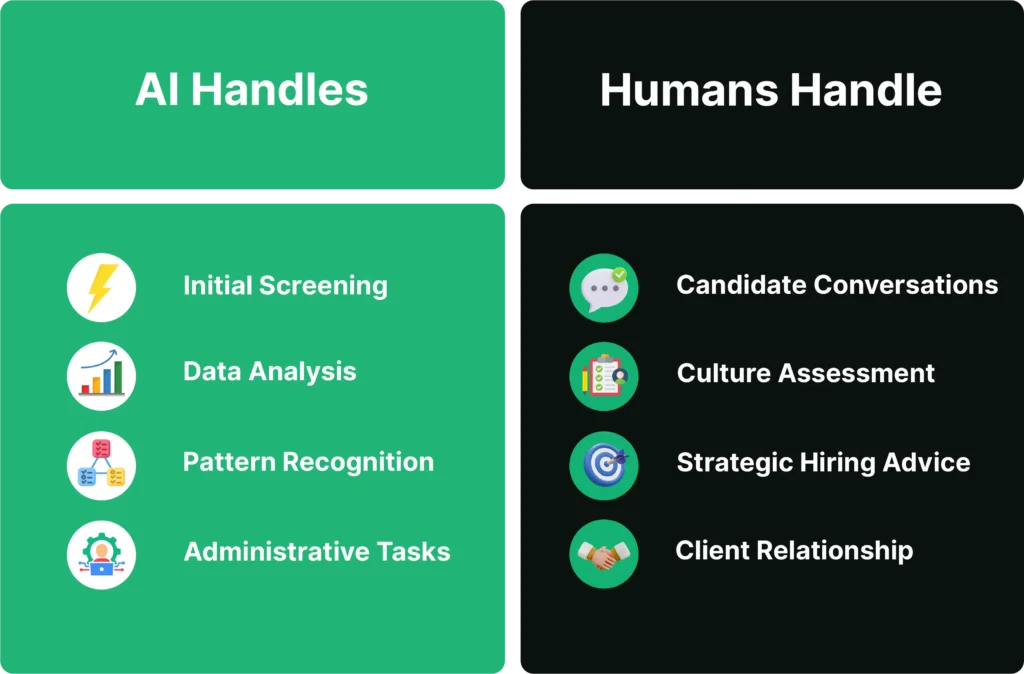
The same thing is happening inside Recruitment Process Outsourcing. A recruiter who once spent half the day screening resumes can now review AI-ranked shortlists. Outreach that used to take hours of writing and rewriting can now start with AI-generated drafts. Even talent mapping, something that used to feel like detective work, can now be supported by data patterns.
But the more technology enters recruitment, the more obvious the human parts become. AI can identify a candidate with the right skills. It can even predict job success based on historical patterns. But it still can’t tell when a candidate is exploring a career shift, or when a hiring manager’s expectations are slightly unrealistic. That still takes a conversation. And a bit of recruiter instinct.
In other words, AI may be brilliant at sorting the puzzle pieces, but humans are still the ones who see the whole picture. And that balance is exactly where modern RPO is heading.
How BPO Wizard Approaches This
The talent market is changing every day. Skills evolve faster than job descriptions. And the competition for good candidates often feels like musical chairs, except the music never stops. AI helps bring order to that chaos. But tools alone don’t solve hiring problems. What matters is how those tools are used.
At BPO Wizard, we’ve seen how AI can improve recruitment workflows, but we’ve also learned something simple along the way. Technology works best when it supports people, not replaces them.
Our RPO teams combine AI-powered sourcing and screening with recruiters who understand industries, hiring managers, and candidate motivations. While AI can process thousands of profiles in minutes, the final hiring decision still comes down to understanding people. And that’s something no algorithm can fully automate.
FAQs:
AI in RPO is like having a smart assistant for hiring. It can handle repetitive tasks, help find the right candidates faster, and screen resumes more efficiently. This frees up recruiters to focus on candidate matters and making sure the hire is the right fit for the team.
Generative AI can take over the routine tasks like writing job descriptions, making postings more visible to the right candidates, and even helping craft personalized outreach messages. This way, recruiters spend less time on repetitive tasks and more time connecting with people who could be a great fit.
AI can help recruiters keep candidates engaged by sending follow-ups, personalizing messages, and reaching out to candidates at the right time. It keeps talent interested and engaged without losing the personal touch, which is key in a competitive hiring market.
AI is powerful, but it’s not magic. Companies often struggle with fitting AI into existing systems, making sure the data is clean, avoiding hidden biases, and keeping the hiring process fair.