

Table of Contents
Let’s talk about a number most agency owners never calculate. A newly hired $100K domestic recruiter is often running a negative contribution margin for the first quarter or two on the job, and the P&L never shows it, because the cost sits buried inside “cost of revenue” instead of broken out per desk.
It’s a unit economics problem, and it’s the real mechanism behind margin compression in US staffing and recruiting right now. The industry itself is proof; After a 10% contraction in 2024 that brought the US staffing market down to $189.0 billion, SIA projected only modest recovery through 2025, meaning most agencies are trying to rebuild margin in a market that isn’t handing it to them for free. At the same time, SHRM’s 2026 benchmarking data shows nonexecutive time-to-fill actually improved to a median of 39 days, while executive cost-per-hire kept climbing.
The Biggest Problem for Recruiting Agencies
The market is getting faster and more expensive at the same time, and agencies stuck on a linear headcount-scaling model are absorbing the cost side without capturing the speed side.
Most owners respond to margin pressure by hiring more domestic recruiters. That’s the trap this article is built to break. Recruiting cost scales linearly with headcount, but placement revenue is lumpy, seasonal, and desk-dependent. If you add bodies before re-architecting the desk itself, you are just adding fixed cost to an already-compressed model.
The $100K Recruiter Trap
What Is the “$100K Recruiter Trap” in Staffing Agency Economics?
The $100K Recruiter Trap is what happens when an agency prices its growth plan off a recruiter’s base salary instead of their fully-loaded cost and ramp-adjusted output. It eventually leads owners to underestimating true desk cost by 40–60% and overestimating near-term placement capacity.
It shows up as a simple, expensive pattern like a $100K recruiter gets hired to “cover the pipeline gap,” the desk doesn’t produce meaningful placements for 90–120 days, and by the time it does, the agency has already absorbed a quarter or two of negative contribution margin on that seat, money that never shows up as a clean line item anywhere on the P&L.
The Fully-Loaded Cost Nobody Puts on One Line
A $100K base salary is the smallest part of the real number. Once you add the standard cost stack, independent cost-of-hiring analyses converge on a fully-loaded cost of roughly $150,000–$200,000+ per year for a US-based recruiter once benefits, payroll taxes, ATS seats, sourcing tool licenses, job board access, and management overhead are included.
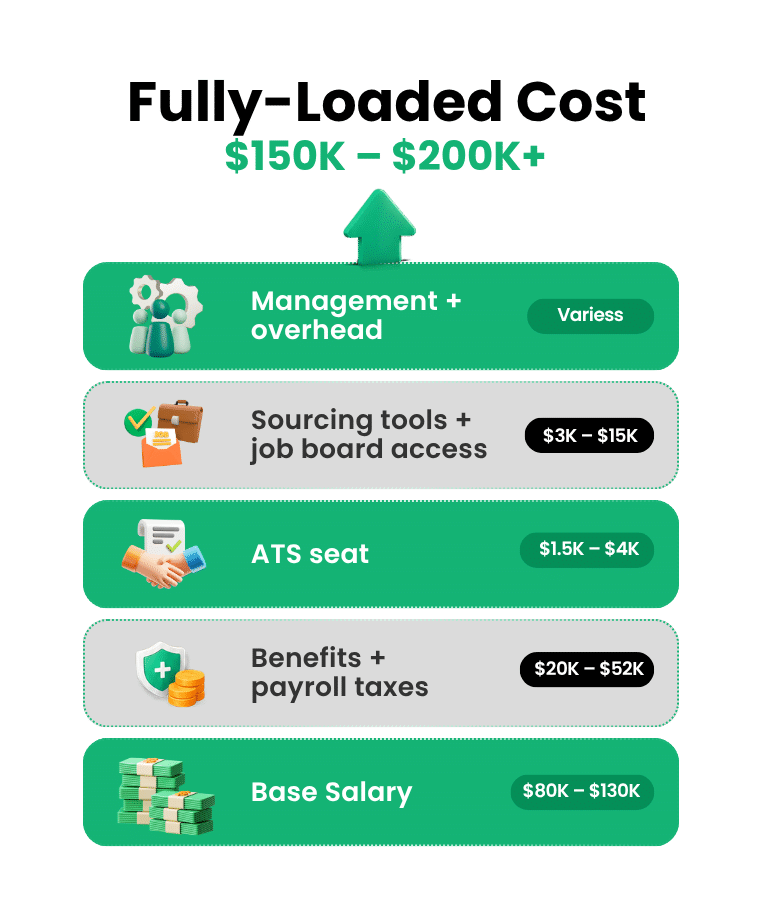
This is directionally consistent with what agencies actually see once every line is captured.
Domestic Desk Breakeven Math
The breakeven question is simple to state and almost never calculated cleanly. And that’s “How many placements does this desk need to close before it stops being a cost center?”
Basic formula:
Breakeven placements per year = Fully-loaded recruiter cost ÷ Average net fee per placement
Contingency placement fees in the US staffing market typically run 15–25% of first-year salary (20% is the common benchmark), while retained/executive search runs 25–35% fee ranges consistent with the American Staffing Association’s own definitions of contingency versus retained search services and corroborated across multiple 2026 fee-structure analyses.
Run these calculations on a mid-market contingency desk at a $175,000 fully-loaded cost and an average fee of $18,000 per placement (20% of a $90,000 average salary), a recruiter needs to close roughly 10 placements a year just to cover their own fully-loaded cost, before contributing a dollar of margin to the agency. Most owners don’t run this number until the margin has already compressed.
Why Ramp Time Is the Real Margin Killer?
Salary is a known, fixed number. Ramp time is the variable nobody prices in, and it’s the actual source of the trap. The first 90–120 days of a new domestic recruiter’s tenure typically produce sourcing and screening activity which means that the fully-loaded cost accrues for a full quarter or more before the breakeven clock even starts.
Most agencies even fire underperforming recruiters on a tenure trigger, 90 days, 6 months, a year, rather than a calculated breakeven point. That’s backwards on both ends. Firing before a recruiter has had a full breakeven cycle destroys the sunk ramp investment, keeping a recruiter well past a missed breakeven point compounds the leak.
The "4-Tier Desk Split": Sourcing, Screening, Account Management, Closing
The 4-Tier Desk Split: Sourcing, Screening, Account Management, Closing
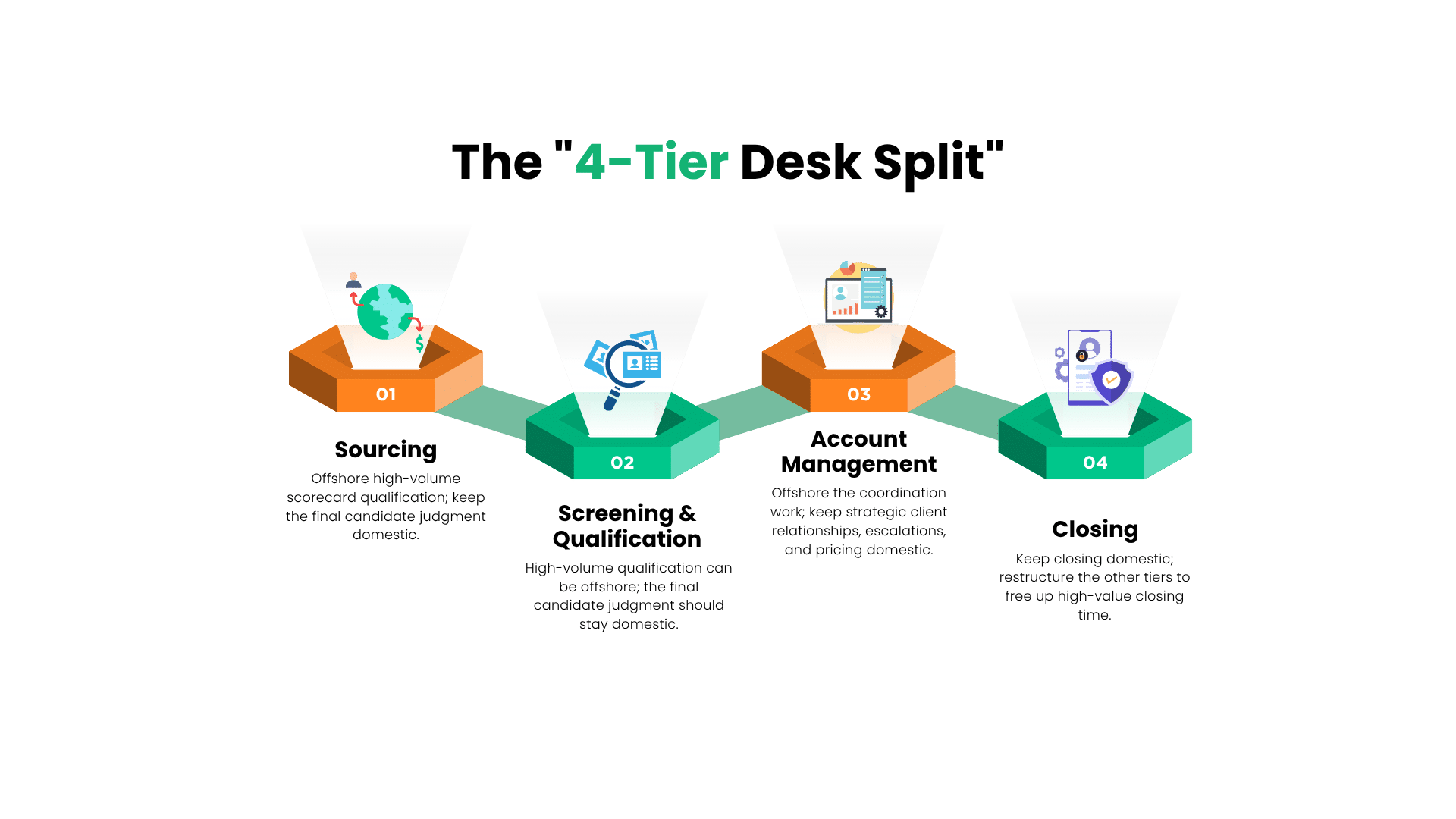
The 4-Tier Desk Split is a cost-to-serve framework that separates a recruiting desk into four functions: sourcing, screening, account management, and closing, and assigns each to the lowest-cost location capable of doing it without degrading candidate or client experience.
The framework only works if you resist treating “outsourcing” as a single binary decision. It isn’t. Each tier has a different cost profile, a different offshore-eligibility profile, and a different sensitivity to error. Getting the split wrong in either direction, over-offshoring or under-offshoring, is its own margin leak.
Tier 1: Sourcing
Sourcing is the highest-volume, most commoditized function on a desk, i.e., Boolean search construction, database enrichment, initial outreach, candidate list building. It’s also the tier with the clearest cost-to-serve case for offshore support, because the work is process-driven and auditable.
Tier 2: Screening & Qualification
Screening splits cleanly into two motions: high-volume qualification against a scorecard (offshore-eligible) and the final judgment call before a candidate goes to the client (best reviewed domestically). Agencies that offshore the entire screening function without a domestic final gate are the ones who show up later searching for “why my last offshore sourcer failed.”
Tier 3: Account Management
Account management is where most agencies assume “offshore” stops, and that assumption is costing them more than they realize. The function actually splits the same way screening does: a coordination layer (status updates, reporting cadence, requisition tracking, CRM/ATS hygiene on the account, scheduling) that’s process-driven and fully offshore-eligible, and a strategic layer (escalations, renewal conversations, pricing discussions) that stays domestic because it’s relationship-equity.
The mistake is offshoring it without drawing that line. A pod that owns the reporting cadence and keeps the account’s data clean frees up the domestic account owner’s time for the conversations that actually protect the relationship, instead of burning it on status updates the client barely reads. Done this way, account management becomes one of the highest-leverage tiers to restructure, because the offshore-eligible portion is high-volume and low-risk, while the retained domestic portion gets more attention.
Tier 4: Closing & Negotiation
Closing is the highest fully-loaded cost per hour on the desk, and it should be protected as such; this is the function whose time you’re trying to free up by restructuring the other three tiers, not a function you offshore.
The agencies that fail at desk restructuring almost always err in one of two directions:
- Offshoring closing (fails immediately, for obvious relationship-risk reasons)
- Keeping sourcing 100% domestic (fails slowly, by overpaying $150K+ fully-loaded cost for work that doesn’t require domestic judgment).
The 4-Tier Split is an argument for stopping the binary framing altogether and pricing each tier on its own cost-to-serve merits.
Cross-Border Legal Isolation vs. Simple Contracting
What “Jurisdictional Shielding” Actually Means in a Sourcing Pod Agreement
Agencies going offshore usually pick between four structures, and the differences between them matter more than most owners realize until something goes wrong:
- Direct freelance/1099 contracting (Upwork, individual contractors): you contract straight with a person, no intermediary entity.
- Employer of Record (EOR): a third party legally employs the worker on your behalf in their home country, while you direct the day-to-day work.
- Your own foreign legal entity: you incorporate locally and hire directly as a foreign employer.
- BPO (Business Process Outsourcing) partnership: you contract with an established operating company that employs, manages, and houses the team under its own entity, and delivers the output as a service.
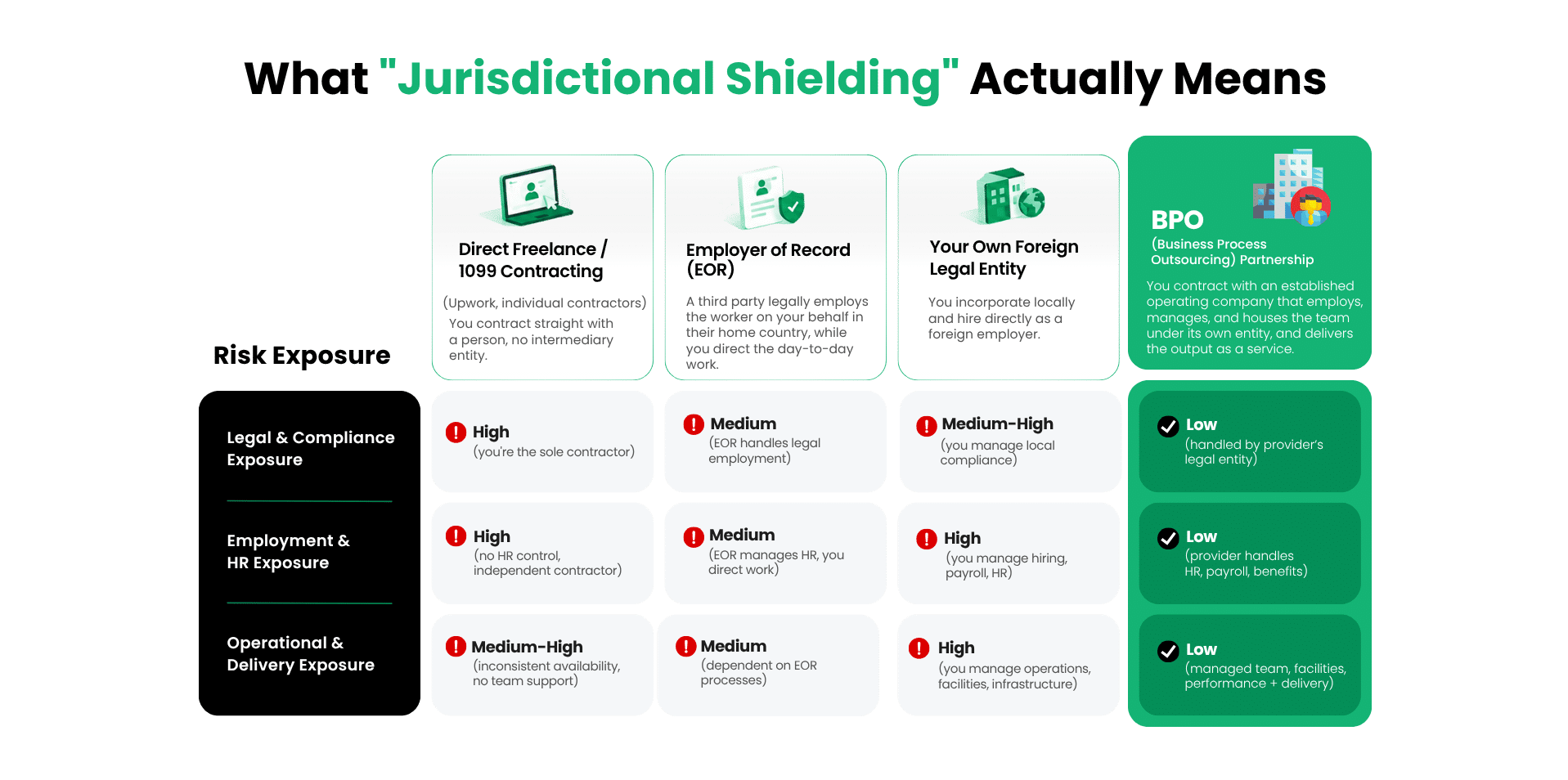
Each of these solves the “can I get offshore labor” question. They don’t solve the same amount of the “who’s exposed if something goes wrong” question.
Direct freelance contracting gives you no legal buffer at all as no entity sits between you and the worker’s employment status, and in many cases the day-to-day direction involved can raise co-employment questions under US labor standards, even though the worker is overseas.
An EOR solves the employment-law piece, but you’re still the one directing daily work, managing performance, and typically still responsible for the systems and data the team touches.
Standing up your own foreign entity apparently solves jurisdictional separation, but hands you the operational burden directly, local compliance, local HR, local infrastructure, which is a lot of fixed overhead for what’s supposed to be a variable-cost move.
So what’s the best offshoring option for recruiting agencies?
A BPO relationship is the only structure of the four where the liability, the employment relationship, and the operational management all sit outside your agency at once. The staff are employed by the BPO, a distinct legal entity operating under its own country’s labor law, while your agency contracts with that entity through a services agreement and a data processing agreement (DPA). Your agency’s direct exposure is generally limited to the terms of that contract. You’re not the employer of record, you’re not managing local labor law, and you’re not the party a foreign labor authority would pursue if something went wrong on the employment side.
That structural completeness also tends to show up in the security posture. A real BPO relationship typically comes with SOC 2-audited controls across security, availability, and confidentiality, an AICPA-developed standard, and a signed DPA defining exactly how candidate and client data is accessed, stored, and restricted. That’s not a small detail: the average cost of a US data breach hit $9.36 million in 2024, according to IBM’s Cost of a Data Breach Report, and accountability for that data stays with your agency regardless of where the breach originated or which structure you chose to get there.
Data Residency, ATS Access Scope, and Chain-of-Custody Basics
Legal isolation isn’t only about who employs the pod; it even covers what the pod can touch. Recruiting data is more sensitive than most agencies treat it day-to-day: candidate PII, compensation data, and client hiring plans are all handled inside the ATS, and a data breach involving this kind of personal data costs an average of $168 per record a number that scales fast once a breach touches a full candidate database rather than a handful of records.
This is why SOC 2 has become close to table stakes in offshore recruiting arrangements rather than a nice-to-have: an estimated 83% of enterprise buyers now require SOC 2 compliance from recruiting software and service vendors. For a sourcing pod specifically, the practical version of this is scoped ATS access (the pod sees only the fields and records its function requires), documented data-handling agreements, and a clear chain of custody for anything exported outside the ATS environment.
Where Generic Freelance/Upwork Contracting Structurally Fails
Generic freelance engagement fails on both axes above at once: there’s typically no entity separation (the individual is a contractor, not an employee of a compliance-bearing pod), and there’s rarely a documented, scoped data-access agreement; the freelancer often works inside the agency’s own ATS login rather than a permissioned, auditable environment. That combination is exactly why “why did my offshore sourcer fail” searches so often trace back to a management and structure problem.
Building High-Signal Feedback Loops
How to Cut Time-to-First-Submittal From 5 Days to 18 Hours
A 5-day time-to-first-submittal mostly comes down to issues with feedback-loop. The candidates existed on day one; the gap between day one and day five is lost to briefing ambiguity, batch-and-wait review cycles, and re-work that a tighter loop would have caught in hours, not days.
The compressed loop, step by step:
- Structured intake sync (30–45 minutes, same day as requisition open): not a job description handoff, but a live conversation that captures the unstated constraints (must-have vs. nice-to-have, comp flexibility, deal-breakers) that job descriptions routinely omit.
- Boolean re-tagging against the live requisition: the sourcing team rebuilds search strings against the actual intake notes and tags candidates against a shared taxonomy so screening isn’t re-interpreting raw search results from scratch.
- Pre-screen scorecard applied before submission: a standardized scorecard, so the domestic reviewer is validating a structured judgment.
- Daily standup loop: a short, structured check-in cycle catches a bad requisition interpretation on day one instead of day four, which is where most of the lost time in a 5-day cycle actually hides.
- Submittal SLA with a hard clock: a defined internal SLA (e.g., first qualified submittal within 18 hours of a clean intake) turns speed into an operational target instead of an aspiration.
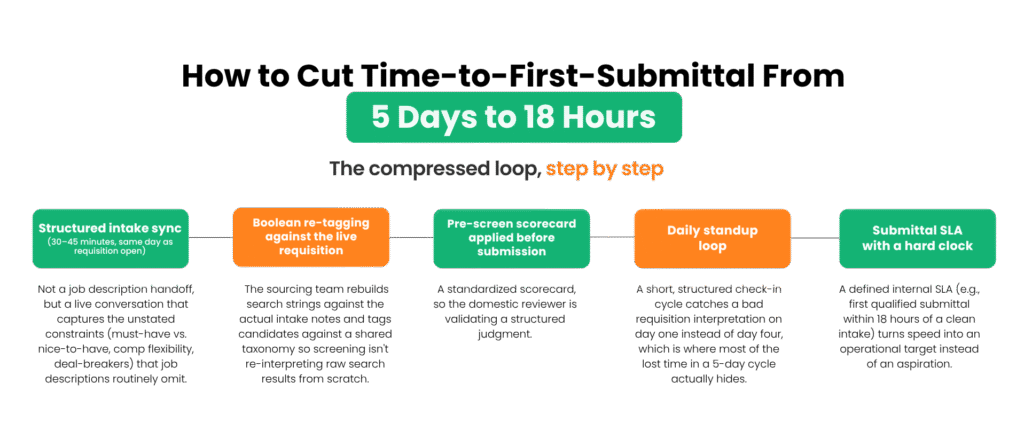
This isn’t a claim that every requisition compresses to 18 hours as role scarcity and market conditions still set a floor. It’s a structural target: the loop above is what closes the avoidable gap between candidates existing and candidates being submitted.
The Feedback Loop Failure Point Most Agencies Never Diagnose
The most common failure is one-way briefing. The account owner hands off a requisition once, the sourcing team executes against it for days without a structured way to flag ambiguity or push back on an unrealistic parameter, and the first real feedback loop happens only when the client rejects the submittal. By then, the wasted cycle is already fully priced in.
The Economics of "Market-Pushback"
Why Passive Head-Nodding Is Costing You Placements (And How to Quantify It)
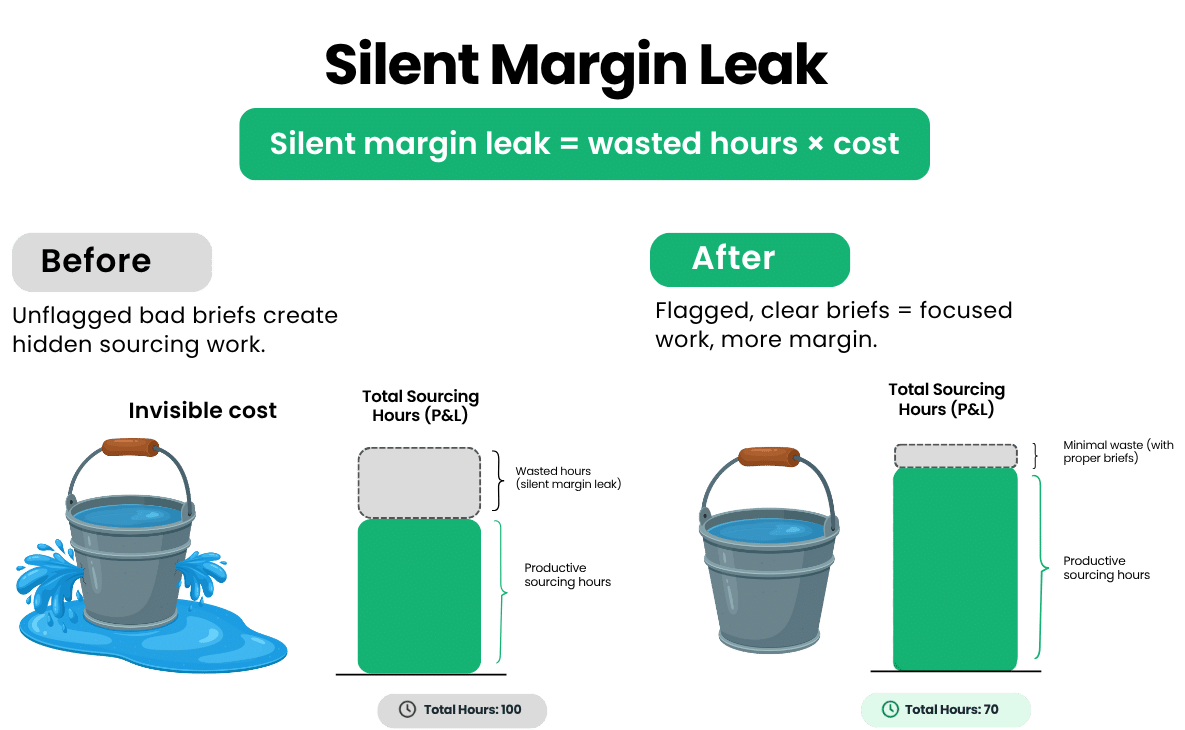
A sourcing team that never challenges a bad brief looks, apparently, like an easy team to manage. It is also, almost always, a hidden cost center, because every hour spent sourcing against a brief with an unrealistic comp range, an impossible skills combination, or a misread client priority is an hour that produces submittals nobody will hire.
The business case for teams that speak up is well documented outside recruiting specifically: Gallup’s research on psychological safety found that moving a team from low to high psychological safety produces a 27% reduction in turnover, a 40% reduction in safety incidents, and a 12% increase in productivity. The recruiting-desk version of that same dynamic is a tea, that’s structurally permitted, and contractually expected, to flag a bad brief before burning sourcing hours against it, rather than executing quietly and letting the client discover the mismatch at the interview stage.
The Real Cost of an Offshore Team That Never Challenges a Bad Brief
The mechanism is simple: a brief that’s 30% below market comp, or that asks for a skills combination that doesn’t exist in the target talent pool, doesn’t fail loudly. It fails slowly, one unqualified or unresponsive candidate at a time, until the account owner eventually notices the pipeline isn’t converting… usually well after a full sourcing cycle has already been spent.
How to Build (and Contractually Require) Pushback as a Deliverable
Structuring pushback as a deliverable, rather than hoping for it culturally, means building it into the intake process itself: a market-data check against the comp range before sourcing begins, a defined escalation path when a brief looks unworkable, and a shared expectation (documented in the SLA, not just implied) that flagging a bad brief early is part of the job.
Quantifying the Leak
Silent margin leak = Wasted sourcing hours × Fully-loaded hourly cost of the pod
A pod that spends even 20% of its sourcing hours against briefs that were flagged as unworkable in hindsight, but never flagged in real time, is losing a fifth of its productive capacity to a process gap. That number is almost always larger than owners expect once they actually track it, because it never shows up as an expense; it shows up as underperformance that gets attributed to sourcing quality instead of process design.
FAQs:
A: Unit economics in a recruiting agency means the revenue and cost attached to a single unit of output, typically one desk or one placement, rather than the agency’s revenue and cost as a whole.
A: A fully-loaded US recruiter typically costs roughly $150,000–$200,000+ per year (about $12,500–$16,700+ per month) once base salary, benefits, payroll taxes, ATS seat costs, sourcing tools, job board access, and management overhead are included, commonly 40–60% higher than the base salary alone.
A: Final client-facing judgment calls should stay domestic, i.e., closing and negotiation, and the strategic layer of account management (escalations, renewal and pricing conversations). Everything process-driven and auditable around those functions, sourcing, high-volume screening against a scorecard, and the coordination layer of account management, is generally offshore-eligible when structured with a scoped, permissioned setup.
A: A BPO (Business Process Outsourcing) partner employs its own staff under its own legal entity and assumes the compliance, employment, and data-handling burden through a services agreement and data processing agreement. Simple contracting, hiring an individual offshore freelancer directly, leaves the US agency exposed to misclassification risk and typically lacks a scoped, auditable data-access structure, since the individual often works inside the agency’s own systems rather than a permissioned environment.