
Table of Contents
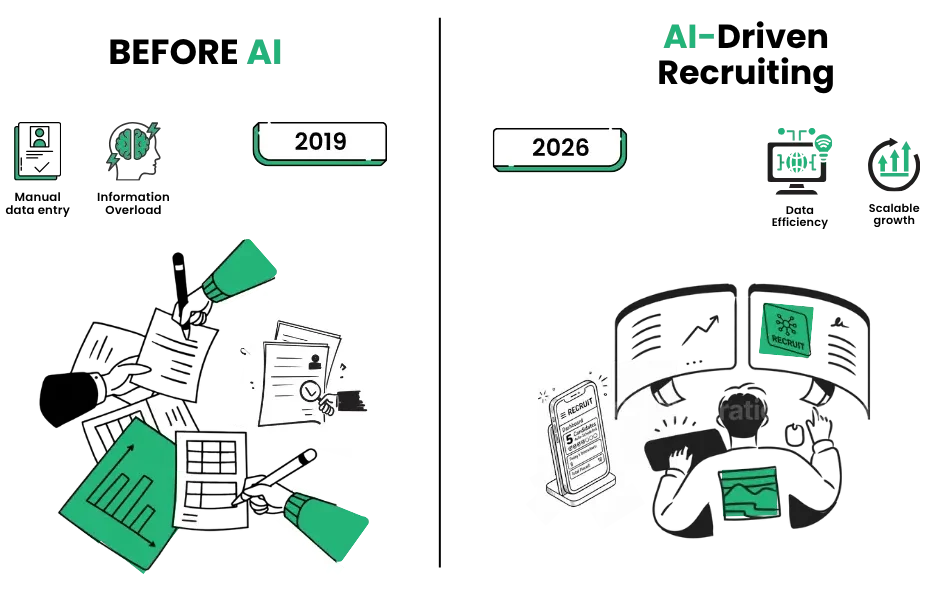
Let’s take a quick trip down memory lane. Picture the life of a Recruitment Process Outsourcing (RPO) recruiter just a few short years ago. We’ll call her Sarah.
Sarah’s typical Tuesday morning involved thirty open browser tabs, three different massive spreadsheets that inevitably crashed her laptop, and an inbox flooded with “Does 2:00 PM on Thursday work for a quick chat?” emails. She spent 70% of her day doing data entry and playing calendar Tetris, leaving her maybe 30% of her time to actually, you know, talk to human beings.
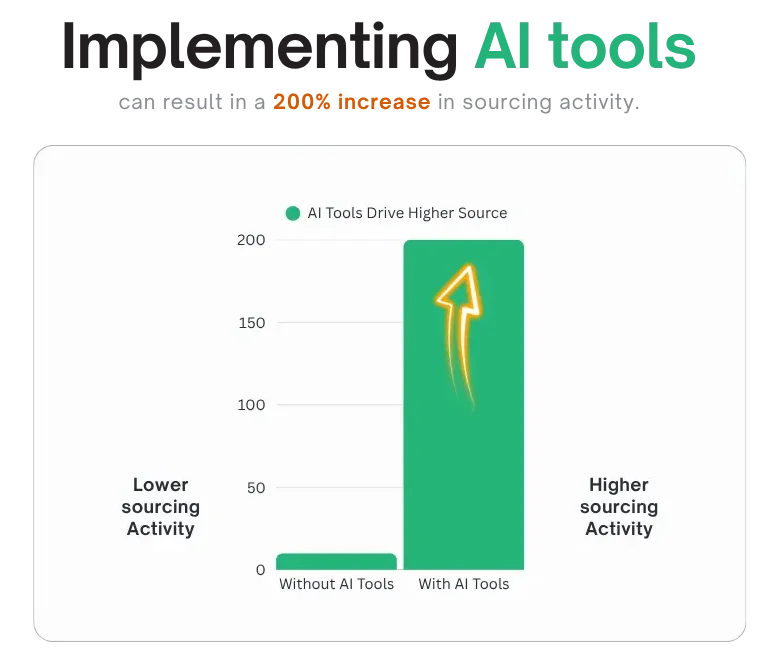
Welcome to 2026. Sarah’s world looks entirely different today.
The recruitment scenario has now changed. Candidates expect lightning-fast application experiences. Clients demand faster time-to-fill metrics and lower costs. To thrive in 2026, RPO teams have realized that throwing more recruiters at a high-volume hiring problem doesn’t work.
Today, we’re going to break down the exact automation tools modern RPOs are using to crush their goals and what to look for when buying the right software for your RPO tech stack.
The Core of a 2026 RPO Tech Stack
Before we start naming specific tools, we need to talk about the philosophy of a modern tech stack. Buying ten new software subscriptions and hoping they naturally talk to each other will only lead you to a massive headache.
Before adopting any new tool in 2026, RPO leaders should evaluate software against four non-negotiable pillars:
- Easy Scalability: RPO hiring is inherently volatile. Your client might need you to hire 10 software engineers in March and 500 seasonal customer service reps in October. If your tech stack crashes, lags, or charges exorbitant, unexpected fees when volume increases, it’s the wrong stack.
- Ethical, Explainable AI: We are well past the “wild west” era of AI recruiting. With global regulations cracking down on algorithmic bias, your tools must feature transparent AI. If an automated system rejects a candidate, you need to know why, and you need to be able to prove that the decision wasn’t based on discriminatory data patterns.
- Mobile-First Everything: Candidates won’t tolerate clunky systems anymore. In fact, recent data from SHRM shows that 60% of job seekers will outright abandon an application if it’s too long or complicated. If they can’t apply from their phone while waiting in line for a latte, you’ve already lost them.
- The “Play Nice” Factor (Open APIs): A brilliant piece of software is completely useless if it exists in a silo. Modern RPOs prefer open API architecture, meaning the tools are specifically built to integrate smoothly with other platforms.
ATS and CRM must-haves
For a long time, the Applicant Tracking System (ATS) was essentially a digital filing cabinet, a place where resumes went to collect virtual dust. Meanwhile, the Candidate Relationship Management (CRM) tool was a totally separate system used for marketing.
In 2026, those lines are blurred. Modern RPOs rely on unified “Talent Intelligence Platforms.”
How Automation Works Here
You shouldn’t be manually parsing resumes anymore. Today’s unified platforms use AI to instantly read a resume, enrich the candidate’s profile with public data (like their GitHub or LinkedIn), and automatically score their match against your open requisitions.
Let’s say you have a new role open up. Instead of starting from scratch, your CRM automatically mines your existing database, finds the “silver medalists” (great candidates who narrowly missed out on past roles), and drops them into an automated, multi-channel outreach sequence via email, WhatsApp, and SMS.
The Big Guns in 2026
Loxo: Loxo has become a massive favorite for RPOs because it combines an AI-driven sourcing engine with an ATS/CRM. It builds your pipeline for you before you’ve even had your morning coffee.
Bullhorn: For enterprise-level RPOs handling massive scale, Bullhorn remains a titan. Its workflow automation capabilities allow you to set “if this, then that” rules that eliminate hours of manual status-updating.
iSmartRecruit: For roles that require heavy LinkedIn networking, iSmartRecruit is great at automating initial touchpoints and follow-ups without sounding like a robotic spam bot.
Interview Automation and Scheduling
If there is one universal truth in recruiting, it’s that time-to-hire dies in the interview scheduling phase. Right now, the global average time-to-hire is 44 days. A huge chunk of those days is wasted in back-and-forth emails coordinating a hiring manager, a recruiter, and a candidate.
In 2026, manual scheduling is viewed as a prehistoric practice.
How Automation Works Here
A candidate moves to the “Interview” stage in your ATS. Instantly, an automated trigger sends the candidate a branded SMS and email with a link. That link looks at the hiring manager’s actual calendar in real-time and shows the candidate available slots. The candidate taps a time, and calendar invites with video links are instantly sent to everyone involved.
Furthermore, conversational AI chatbots sit on career pages 24/7. They can answer a candidate’s questions about benefits at 2:00 AM, ask pre-screening questions, and automatically schedule a phone screen with a human recruiter for the next feasible time if the candidate passes the initial criteria.
The Big Guns in 2026
Paradox (Olivia): Olivia is arguably the queen of conversational AI. For high-volume hiring, having an AI assistant text with candidates, screen them, and get them on the calendar automatically is something we all want.
GoodTime: If your client requires complex, multi-panel interviews (e.g., a software engineer needing to meet with four different team leads), GoodTime automates that incredibly complex calendar tetris.
Calendly for Enterprise: Calendly is a classic for a reason. Its deep integrations and round-robin scheduling features make it a staple for getting initial recruiter phone screens booked effortlessly.
Analytics Tools and Dashboards
Telling a client, “Trust me, it’s just a really tough talent market right now,” doesn’t fly. Clients are paying an RPO to be strategic advisors, and advisors need hard data to prove their ROI.
We’ve moved far beyond reactive reporting (looking at what happened last month) into proactive, predictive analytics.
How Automation Works Here
Instead of manually exporting CSV files to build a clunky pie chart, today’s RPO leaders use automated dashboards that update in real-time.
These tools go deeper when tracking the standard metrics like ‘Time-to-Fill’ and ‘Cost-per-Hire.’ They automatically track source channel effectiveness, telling you exactly which job board or specific LinkedIn campaign is bringing in hires and allowing you to reallocate your advertising spend. More importantly, the dashboard will proactively flag if candidates are dropping out at a specific stage (say, after the take-home assessment), so you can fix the process before you lose more talent.
The Big Guns in 2026
Visier: Visier is the gold standard for people analytics. It pulls data from your ATS, HRIS, and payroll to give incredible insights into quality-of-hire and predictive retention.
Native ATS Analytics (like iCIMS): Platforms like iCIMS have beefed up their native analytics so much that many teams don’t even need a third-party tool. You can build custom, client-facing dashboards right inside the system.
Tableau: For highly customized, deeply complex client reporting, integrating your ATS data straight into Tableau through API is still the best way to build a visual narrative of your recruiting success.
Integration Strategies Future of Inclusive Hiring
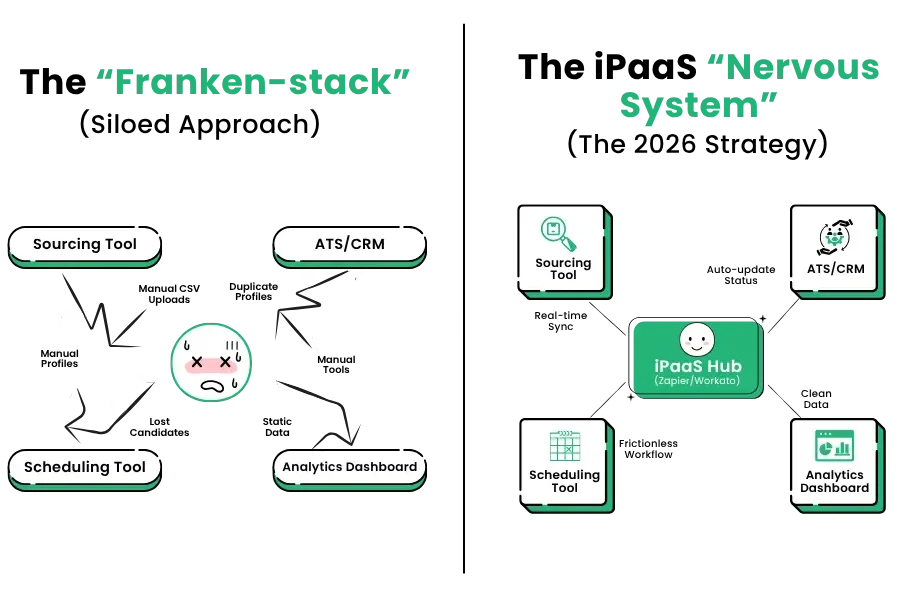
We have touched on this in the beginning, but it bears repeating. Having ten world-class tools is actually a liability if they don’t communicate. We call this the “Franken-stack,” a monster made of disconnected parts that requires manual data entry to keep alive.
The iPaaS Approach
So now, how do we solve this? Through Integration Platform as a Service (iPaaS) tools. iPaaS is like the central nervous system of your tech stack. Tools like Zapier, Workato, or Tray.io sit in the middle of your software suite and translate data back and forth.
Native vs. Custom Integrations
When building your stack, always look for native integrations first. If your scheduling tool natively integrates with your ATS at the click of a button, use it. But for highly specific client needs, a good RPO team knows how to use iPaaS to build custom API bridges.
Maintaining Data Hygiene
The one danger of high-level automation is creating a mess really fast. If your CRM and ATS aren’t syncing perfectly, you might end up with duplicate candidate profiles. Worse, you might have an automated system send an outreach email to a candidate who was just rejected by a hiring manager yesterday. A strong integration strategy focuses heavily on deduplication rules.
Bottom Line
Building a 2026-ready RPO tech stack is creating an uninterrupted flow from the moment a candidate is sourced to the moment they sign their offer letter. By unifying your ATS and CRM, automating the nightmare of scheduling, leveraging predictive analytics, and tying it all together with smart integrations, you eliminate the factors that might slow down hiring.
But automation does not replace human recruiters. Nobody wants to be hired by a robot. The entire purpose of this technology is to handle the administrative and repetitive burden. When your tech stack is running perfectly in the background, your recruiters, just like Sarah, will get to spend their time doing what they do best.
And if you’d want to meet this Sarah and many other people like her, BPO Wizard’s RPO recruiters are exactly who we were talking about.
FAQs:
While it depends on the specific client’s needs, a unified ATS and CRM platform with AI sourcing and automated outreach is the foundation. Without a strong central hub, other automation tools cannot function well.
No. Automation and AI are designed to reduce the administrative workload, such as resume parsing, data entry, and interview scheduling. By removing these, recruiters get more time to do what AI can’t. They can focus on building genuine human relationships and consulting with hiring managers.
Automation reduces time-to-hire by a huge margin. It instantly moves candidates through the funnel. Instead of waiting days for a recruiter to manually review a resume and email some interview times, AI can match a candidate’s skills and send an automated self-scheduling link through text message within seconds. It’s the difference between a 44-day hire and a 14-day hire.
iPaaS as the “universal translator” for your apps. It’s the digital glue (like Zapier) that makes sure when you update a candidate’s status in one tool, it automatically changes everywhere else without you lifting a finger.
In 2026, diversity is viewed as a Risk Management metric. A homogenous workforce is a sign of a company that is out of touch with a global, diverse marketplace. Investors now recognize that the lack of a representative workforce leads to market blindness, lower innovation, and higher turnover, all of which directly impact the bottom line.