

Table of Contents
The traditional Diversity, Equity, and Inclusion (DEI) model is facing a structural collapse. For years, organizations treated DEI as a peripheral HR function or a defensive compliance measure. In 2026, that passive approach has become a high-stakes liability as the modern market no longer rewards participation trophies for diversity. Instead, it demands tangible and cognitive output driven by a truly inclusive workforce.
A winning 2026 talent strategy moves beyond the performative and inserts DEI directly into the recruitment process to optimize human capital. Leaders are now realizing that a conventional hiring culture takes a toll on innovation, further creating a workforce that is too uniform to solve complex global problems.
The Influence of Global Workforce Diversity Trends on Hiring Decisions
The talent landscape of 2026 is unrecognizable compared to the start of the decade. The geographic and demographic centers of gravity have shifted, and the businesses that fail to adapt are finding themselves starved of elite talent.
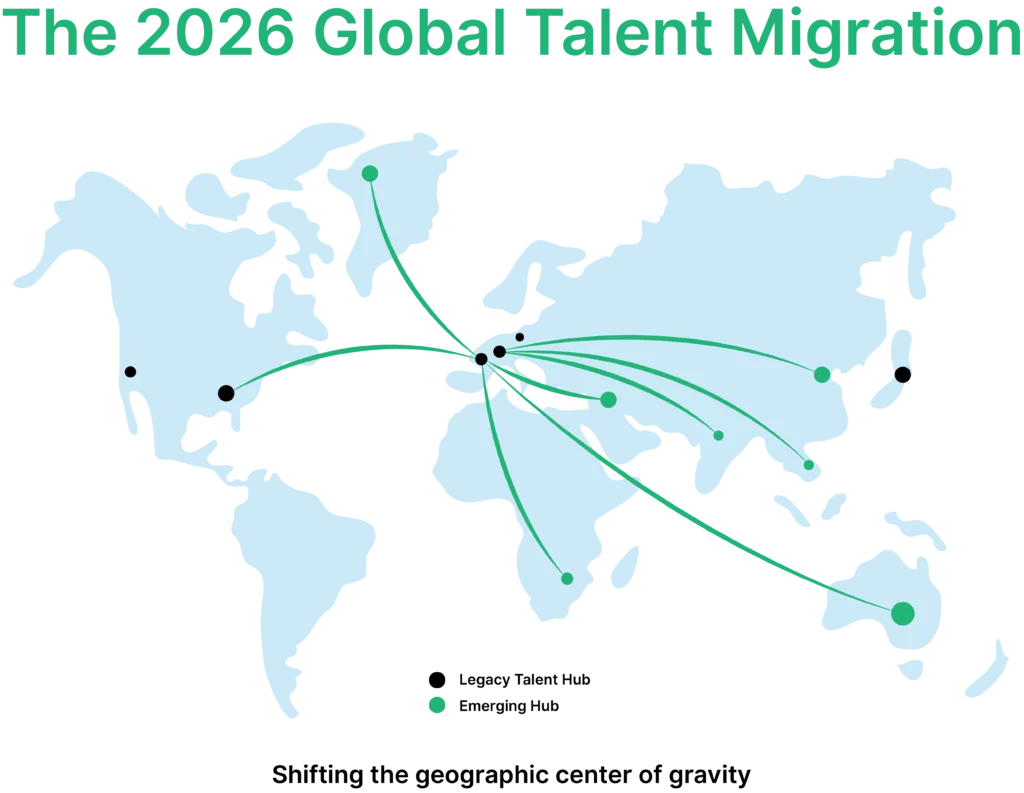
How workforce demographics are changing across major markets
Workforce demographics across major markets are undergoing a permanent transformation. In the US and Europe, Gen Z and Gen Alpha now dictate cultural norms, prioritizing equity as a non-negotiable condition of employment. Simultaneously, the rise of Global South talent hubs means your next lead engineer is just as likely to be in the Western Hemisphere as they are in the East. Managing this distributed, diverse reality requires a sophisticated cultural architecture.
Why legacy hiring models fail diverse talent pools
The Old Guard hiring machine was built on the myth of the culture fit. In practice, culture fit often acted as a coded filter for sameness. Traditional funnels rely on narrow sourcing channels and rigid pedigree requirements that systematically overlook unconventional high-performers. When you hire from the same three universities, or the same region of the USA, or the same four competitors, you are capping your organization’s intellectual ceiling and limiting the diversity.
Why Clients Now Demand DEI-Driven Recruitment Models
We have entered an era where social proof is a primary currency and stakeholders are calling out DEI debt at every level.
DEI as a board-level and investor concern
Diversity has officially migrated from the HR handbook to the quarterly earnings call. Institutional investors now view DEI as a proxy for sophisticated risk management. A homogeneous leadership team is seen as a signal of groupthink, a precursor to market blindness. Boards are now demanding data-driven proof that their recruitment partners can deliver a workforce that reflects their global customer base, not just limited to Europe or the USA.
The gap between DEI promises and hiring reality
The biggest frustration for CEOs in 2026 is the gap between their public DEI statements and their actual hiring data. Most companies have the right intentions but the wrong mechanics. They set ambitious targets but utilize outdated Recruitment Process Outsourcing (RPO) models that aren’t equipped to find or land underrepresented talent. This disconnect creates a revolving door, with diverse hires brought in but quickly leaving because the underlying system was never built for their success.
The Role of RPOs in Scaling Inclusive Hiring
To bridge the execution gap, the 2026 RPO must act as a strategic designer. They need to redesign the ecosystem to ensure equity is a default setting, not a manual override.
Inclusive sourcing beyond traditional talent pools
Strategic RPOs have abandoned the post-and-pray method. They utilize proactive talent mapping to engage with communities, professional associations, and digital spaces where diverse talent actually lives. This involves building long-term talent pipelines rather than reacting to immediate vacancies. By the time a role opens, the inclusive sourcing work has already been happening for months.
Embedding DEI across the candidate lifecycle
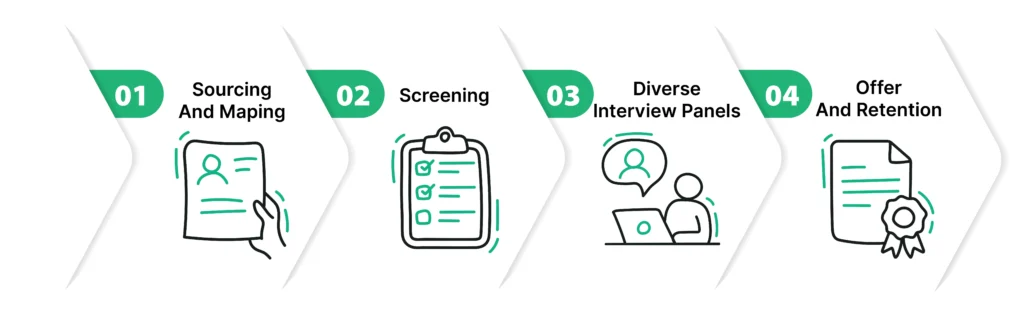
Relying on a recruiter’s good intentions to drive diversity is a failing strategy. High-performance RPOs embed DEI into the system itself. This includes anonymized resume screening, standardized interview scorecards to neutralize affinity bias, and diverse interview panels. By hard-coding these steps into the workflow, you remove the influence of gut feelings and replace them with objective data.
Metrics, Accountability, and Governance in DEI Hiring
If you cannot measure it, you cannot manage it. The standard for DEI reporting has moved from vague percentages to granular, actionable insights.
Defining Meaningful DEI Metrics
Meaningful metrics focus on the pulp of the process, not just the final result. Leading organizations track the Pass-Through Rate of diverse candidates at every stage of the funnel. If your initial pool is 50% diverse but your final round is 5% diverse, you have a bias problem in your interview process.
Accountability Frameworks That Drive Behavior
Real change happens when DEI goals are tied to performance reviews and compensation. In 2026, the most successful RPO partnerships include Service Level Agreements (SLAs) that specifically address diversity benchmarks. When a hiring manager’s ability to scale their team is linked to their ability to build a diverse one, unconscious bias miraculously disappears.
Technology, Ethics, and the Future of Inclusive Hiring
Artificial Intelligence is the great double-edged sword of 2026 recruitment. It has the power to either scale equity or automate discrimination at an unprecedented speed.
Where technology strengthens DEI outcomes
When used correctly, AI is a powerful tool for objective analysis. Advanced algorithms can now audit job descriptions for gendered language or identify hidden gems in a database whose skills match a role, even if their job titles don’t. These tools help human recruiters see beyond the surface and focus on the candidate’s core capacity.
The Non-Negotiable Human Oversight
Despite the power of AI, human judgment remains the final arbiter of talent. The Ethical Risk is the black box algorithm that learns the biases of its creators. Constant human auditing of AI tools is mandatory to ensure they aren’t inadvertently screening out qualified candidates based on proxy data. Technology provides the data, but humans provide the wisdom.
Business Outcomes of a Strong DEI Talent Strategy
Ultimately, DEI is a performance play and inclusive hiring is primarily driving the bottom-line results.
1. Performance and Retention
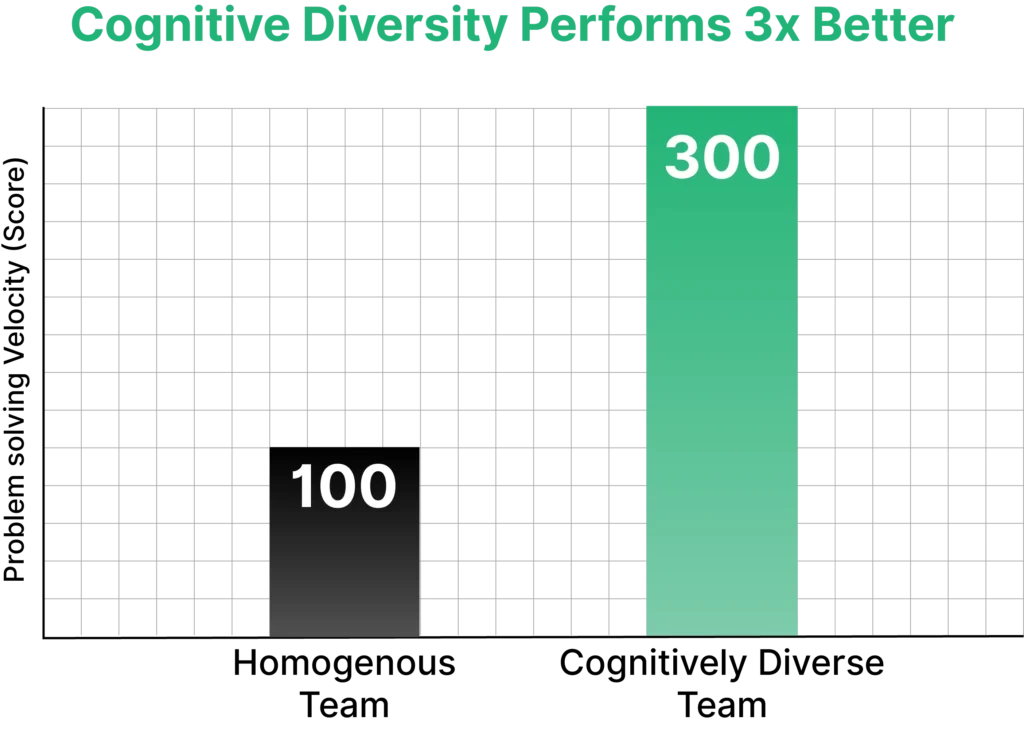
According to the Niagara Institute, teams with high cognitive diversity solve problems up to 3 times faster than homogenous teams.
2. Market Agility
A diverse workforce understands a diverse market. This cultural intelligence allows companies to pivot into new regions and demographics with fewer missteps.
3. The Talent Magnet
In a tight labor market, your DEI reputation is your strongest recruiting tool. Top talent, regardless of their own background, prefers to work for organizations that demonstrate a commitment to equity.
Conclusion
The strategies of treating DEI as an extra or a defensive compliance measure is long outdated. An inclusive hiring strategy is now a high-performance requirement for any organization that intends to outpace the market. Most organizations fail in their DEI goals because they have the right intentions but the wrong mechanics. They rely on outdated systems that are accidentally designed for sameness. Success belongs to the leaders who treat inclusive talent acquisition with the same structural rigor as their digital infrastructure.
This is where a strategic design partner changes the trajectory. BPO W. helps businesses bridge the gap between DEI promises and hiring reality by hard-coding equity into the recruitment ecosystem. We help you eliminate bias, identify hidden talent in global hubs, and build cognitively diverse teams. Don’t let DEI debt take a toll on your innovation. Book a call to transform your recruitment function into a strategic engine that powers your growth for 2026.
FAQs:
Internal teams often struggle with institutional blindness and limited sourcing reach. A strategic RPO acts as a builder, bringing specialized tools, like AI-driven bias neutralizers, that are often too costly or complex to build in-house. They move DEI from a manual effort by recruiters to a system-level design that functions automatically.
Standard diversity hiring often only looks at the result (who was hired). Pass-through metrics analyze the candidate journey at every stage: application to screening, screening to interview, and interview to offer. If diverse candidates are dropping off at the interview stage, it signals a bias problem within your hiring manager pool rather than a sourcing problem. This data allows for measured fixes rather than broad, ineffective changes.
It is both. AI is an asset when used to audit job descriptions for gendered language or to find Skill Shadows that humans might overlook. However, it becomes a liability if left unmonitored, as algorithms can learn and scale existing human biases. The 2026 standard requires human oversight to ensure technology provides the data while humans provide the ethical judgment.
The shift is from Culture Fit to Culture Add. Instead of looking for people who think and act like the current team, leaders should look for candidates who share the company’s core values but bring different life experiences and problem-solving styles.
In 2026, diversity is viewed as a Risk Management metric. A homogenous workforce is a sign of a company that is out of touch with a global, diverse marketplace. Investors now recognize that the lack of a representative workforce leads to market blindness, lower innovation, and higher turnover, all of which directly impact the bottom line.