

Table of Contents
For decades, hiring followed a familiar rhythm inside most U.S. companies.
A role opened followed by a live job description. Recruiters searched for candidates, interviews happened and an offer was made.
This process worked reasonably well when companies moved slowly and talent markets were predictable. But RPO trends in 2026 make a completely different deal.
Now the markets shift faster, the task descriptions and needs evolve quickly and entire functions inside organizations can transform within a year. This acceleration is reflected in the market as the global RPO industry is projected to reach USD 19.6 billion in 2026. So, this is where the old hiring model begins to break.
The companies outperforming their competitors today are doing something much more intentional than just hiring faster. They are designing the capabilities their workforce will need before the hiring even begins.
In other words, they are treating talent as strategic infrastructure.
The most advanced organizations now partner with RPOs to design and orchestrate the talent ecosystems that power growth rather than just filling roles.
Why Traditional Recruiting Models Are Failing in 2026
Before looking at the future of RPO, it helps to understand why the traditional hiring model began to break down in the first place.
The issues did not appear overnight. Instead, they built slowly as companies adopted new technology without changing the underlying recruiting philosophy. By 2025, the cracks were impossible to ignore.
Automation Without Strategy
Over the last few years, organizations invested heavily in recruiting technology.
Applicant tracking systems became smarter, artificial intelligence dominated the screening tools and interview scheduling no longer needed the manual effort.
These tools were designed to make recruiting more efficient, and in many ways they did. But efficiency alone does not guarantee better hiring outcomes.
As a matter of fact, automation failed to improve the quality of decisions despite increasing the volume of applications flowing into hiring pipelines. Recruiters were suddenly dealing with more candidate data, more profiles, and more signals. Many hiring teams experienced something closer to overload when the clarity was expected.
Automation accelerated activity, but it did not create strategy.
The Candidate Experience Breakdown
Technology also introduced another problem that few companies anticipated.
As automation expanded, the human interaction in recruiting began to shrink.
Candidates started receiving automated messages, interview updates were delayed and communication gaps widened.
Many job seekers now describe the hiring process as frustrating or impersonal. In fact, 61% of job seekers report being ‘ghosted’ after interviews.The phenomenon became so widespread that it gained a nickname across professional communities.
The “ghosting epidemic.”
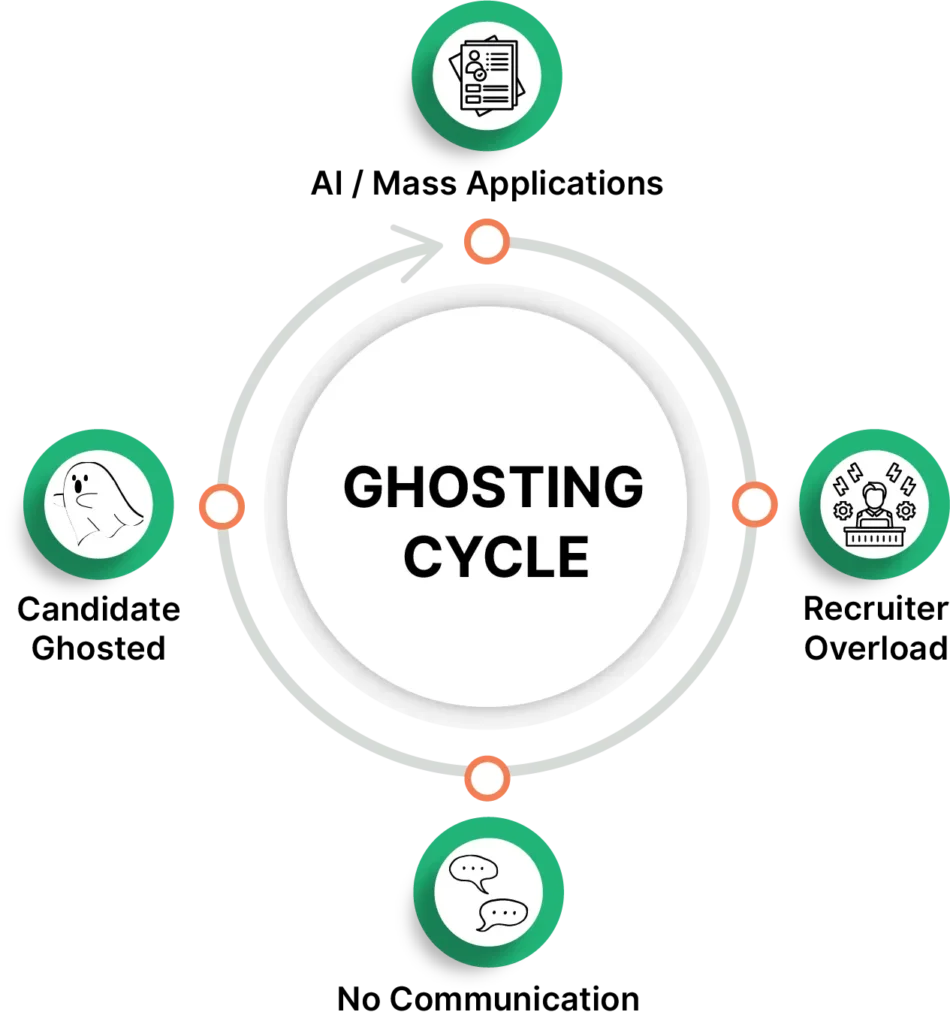
Candidates would apply to roles, complete interviews, and then hear nothing. From the company’s perspective this often happened because recruiters were overwhelmed.
From the candidate’s perspective, it felt like disregard.
Hence, the disconnect widened between employers and the talent they were trying to attract.
Hiring Detached from Business Strategy
Perhaps the most important problem with traditional recruiting is the question it tries to answer.
Most hiring processes revolve around one metric and that’s how quickly a position is filled.
But business leaders are asking a different question in 2026. They are assessing and shortlisting the capabilities that their organization will need to compete in the next 12 to 24 months?
That difference might sound subtle, but it completely changes how hiring decisions are made. When recruiting focuses only on filling roles, it becomes reactive. But strategy becomes the focus when it focuses on building capabilities.
And this is exactly where modern RPO partners are creating value.
How RPO Is Evolving Into Strategic Workforce Architecture
The most advanced RPO providers in 2026 no longer operate as simple recruiting services. They function more like workforce architects. Instead of responding to individual job openings, they help organizations design the systems through which talent operates.
It has introduced the concept of Strategic Workforce Architecture (SWA).
What Strategic Workforce Architecture Looks Like
Workforce architecture starts by asking three important questions.
- What capabilities will the business require to achieve its next stage of growth?
- How should talent be structured so those capabilities can operate effectively?
- Where should technology or automation augment human expertise?
Organizations begin building capability clusters rather than filling roles. These clusters combine skills, technology, and collaboration into functional units that move faster than traditional departmental structures.
From Job Roles to Capability Clusters
Consider a common example.
In the traditional model, a company might open a role for a backend developer. The hiring team searches for candidates, evaluates experience, and selects someone who can perform the role. But a workforce architecture approach looks at the problem differently.
Rather than hiring one developer, the organization might build a small capability pod consisting of:
- a full-stack engineer
• an AI-assisted quality assurance specialist
• a product data analyst
Together these roles create a system that can design, test, and refine software more efficiently than a single position could manage. This type of thinking increases what leaders often refer to as organizational velocity. And it is one of the reasons RPO partnerships are expanding beyond recruiting tasks into broader workforce strategy.
AI-Driven RPO Trends Transforming Talent Acquisition
Artificial intelligence is transforming recruiting, but not in the way many headlines suggested a few years ago.
Early conversations about AI focused on automation. The expectation was that algorithms would eventually replace large portions of the recruiting process.
What actually emerged instead is something more nuanced.
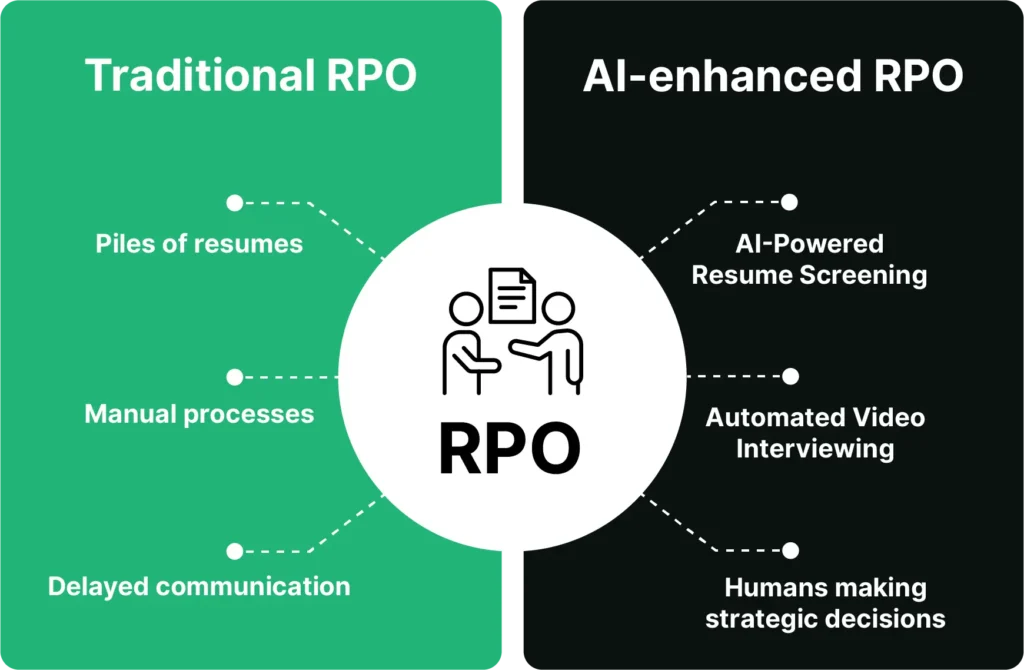
The real value of AI in talent acquisition lies in orchestration rather than replacement.
Agentic AI in Talent Operations
Modern RPO platforms now deploy AI-driven agents that support recruiters across several areas of the hiring process.
These systems can verify candidate credentials, schedule interviews across multiple calendars, and analyze communication patterns during candidate interactions. Some tools can even monitor engagement signals from applicants, helping recruiters identify which candidates are most interested in moving forward.
But despite these capabilities, the most successful organizations maintain what experts call a human-in-the-loop framework such that the AI handles the operational complexity whil the humans retain responsibility for judgment.
The New Role of Recruiters
When administrative tasks disappear, recruiters gain something valuable. Time.
Recruiters can focus on higher-impact activities instead of managing spreadsheets, coordinating schedules, and screening endless applications.
They guide candidates through important career decisions, advise hiring managers about market conditions and help align talent choices with the organization’s long-term direction.
Recruiters are still process administrators, but they have upscaled to being career strategists in the same role. This one single change has elevated the entire hiring conversation.
Candidate Experience 3.0: The Consumerization of Hiring
Another major change in modern talent acquisition is the way candidates interact with employers.
Job seekers today expect hiring experiences that feel as intuitive and responsive as the digital platforms they use every day.
That expectation has pushed RPO providers to rethink how recruiting journeys are designed.
Dynamic Role Previews
Traditional job descriptions rarely provide the information candidates actually want.
They list responsibilities, qualifications, and reporting structures, but they often leave out context.
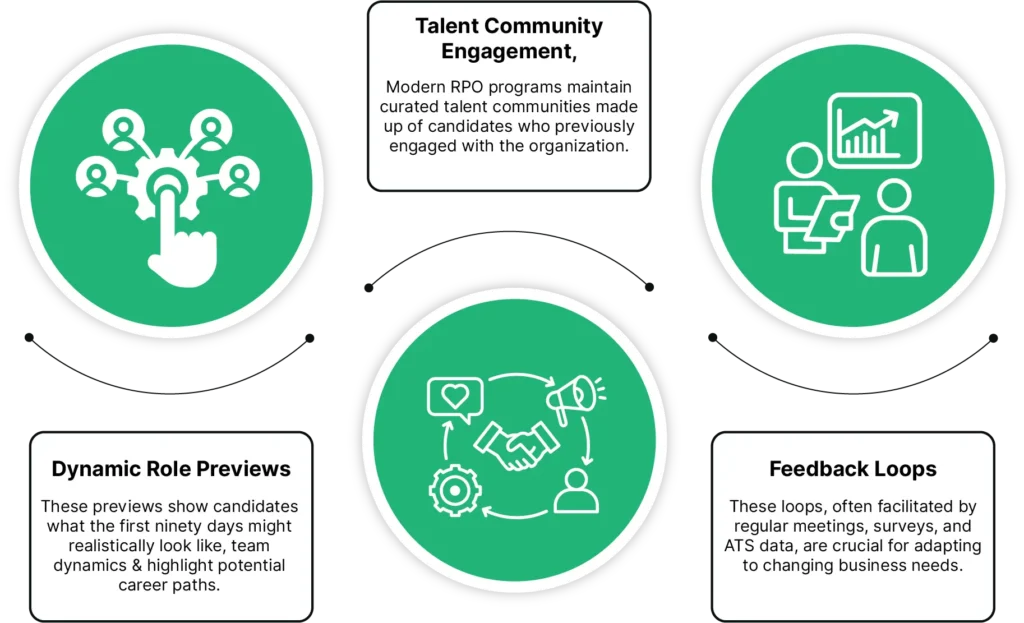
In response, some RPO partners now create dynamic role previews. These previews show candidates what the first ninety days might realistically look like. They describe team dynamics and highlight potential career paths.
Candidates gain a clearer understanding of the opportunity before committing to the process. The result is better alignment between employer expectations and candidate motivation.
The Rise of Talent Communities
In the past, candidates who were not selected for a role typically disappeared from the hiring pipeline. Today that approach is changing. Modern RPO programs maintain curated talent communities made up of candidates who previously engaged with the organization.
These “silver medalist” networks allow companies to reconnect with qualified professionals when new roles emerge.
Companies can activate an existing ecosystem of interested talent rather than restarting the recruiting process from scratch. This approach shortens hiring timelines while preserving relationships that would otherwise be lost.
Traditional Hiring vs. Modern RPO Trends: A Comparison A Comparison
Key Metrics Driving RPO Success in 2026
For many years, recruiting success was measured using metrics that looked impressive but offered little insight into real business outcomes.
Common examples include time-to-fill, cost-per-hire, and applicant volume.
While these numbers provide operational visibility, they do not necessarily reveal whether a hiring decision improved organizational performance.
Modern RPO programs are shifting attention toward metrics that directly connect talent with business results.
Key Metrics Dashboard
- Visual: Simplified dashboard graphic showing Time-to-Productivity, Quality of Match, and Talent Debt indicators.
- Design: Clean, modern, with graphs or speedometer-style visuals.
Time-to-Productivity
The most important question for many leaders is not how quickly a role was filled.
It is how quickly the new hire began contributing meaningful value.
Time-to-Productivity measures how long it takes for an employee to reach effective performance levels within their role.
Reducing this timeline often has a larger impact on growth than simply accelerating the hiring process.
Quality of Match
Another metric gaining attention is Quality of Match. Organizations track outcomes after the hire instead of evaluating candidates only during interviews.
Performance reviews, manager satisfaction scores, and retention data provide a clearer picture of whether a hiring decision truly aligned with the company’s needs. It transforms hiring from a short-term transaction into a measurable long-term investment.
Understanding Talent Debt
One concept that is becoming increasingly relevant in workforce discussions is Talent Debt.
Talent Debt represents the hidden cost created when critical roles remain unfilled for long periods. Projects slow down and innovation comes to a halt. Even existing employees experience additional pressure as they compensate for missing team members.
Over time, these hidden costs accumulate and affect the organization’s ability to compete.
Advanced RPO partners help companies identify and reduce Talent Debt before it begins affecting performance.
RPO as a Business Growth Engine
The most important transformation in the RPO industry is rarely discussed in traditional recruiting conversations.
Modern RPO partnerships enable organizational scalability.
As companies grow into new markets, launch new products, or restructure teams, the complexity of talent operations increases dramatically.
RPO partners provide the infrastructure needed to manage that complexity.
Global Talent Elasticity
Expanding into new regions presents many challenges for growing companies, and talent infrastructure is often one of the most difficult. Local employment regulations, cultural differences, and limited recruiting networks can slow expansion efforts.
Modern RPO providers solve this challenge by offering global talent pipelines, regional compliance expertise, and scalable recruiting systems. With these resources in place, companies can expand teams across new markets far more quickly than they could on their own.
Handling the New Hiring Risk
Hiring today involves more legal and operational complexity than it did even a few years ago.
Regulations around AI bias in hiring tools are evolving and cross-border employment laws vary widely. To add more, remote workforce governance introduces new compliance requirements.
In this environment, RPO partners often act as strategic advisors who help organizations deal efficiently with these risks. Their role extends beyond recruitment into areas such as workforce planning, compliance guidance, and operational design.
The New Role of RPO in 2026
The companies winning the talent race today are the ones that design their workforce intentionally.
Recruitment is no longer just a function within HR. Contrarily, it is a core element of business strategy that influences innovation, productivity, and long-term growth. And that has changed businesses’ expectations from their RPO partners.
Companies now engage RPO providers to expand the organization’s operating capacity rather than solely reducing recruiting costs or managing hiring pipelines.
Because in a world where skills evolve quickly and competition moves faster every year, talent is more than just a resource.
It is the architecture that determines how far a business can grow.
A Final Question for Leaders
Look closely at your hiring process today.
Is it built for reactive recruiting?
Or is it designed to support strategic workforce growth?
The answer to that question may determine how well your organization competes in the years ahead.
FAQs:
Major trends include AI‑augmented talent orchestration, strategic workforce architecture, predictive hiring analytics, dynamic candidate experiences, and global talent elasticity. RPO partners are also increasingly offering full workforce strategy support rather than only filling roles.
The global RPO market is projected to reach nearly USD 19.6 billion in 2026 which reflects a strong enterprise adoption and growing reliance on outsourced talent acquisition strategies.
Companies outsource to access specialized expertise, improve hiring efficiency, enhance candidate quality, scale hiring across regions, and build strategic workforce plans that align with long‑term business goals.
AI is being used for screening, candidate engagement, scheduling, and analytics. AI doesn’t replace recruiters but augments operations that allows humans to focus on strategic decisions and candidate relationships.