
Table of Contents
The hiring strategies that once felt like a safe bet now carry a hidden tax most leaders aren’t prepared to pay. The traditional hiring machine, consisting of six-month funnels, rigid role definitions, and permanent-first thinking, is no longer working.
A winning 2026 hiring strategy replaces that old model with dynamic capacity planning, keeping core critical talent on board while building a flexible, high-performance layer of outsourced specialists. The era of predictable growth and stagnant skillsets is officially in the rearview mirror.
That means your strategic plan needs more than a tweak; it demands a complete structural reset. This is how we escape the hiring for the sake of hiring trap and finally build a workforce that truly breathes with the market.
The 2026 Reset: Why Business as Usual is a Risk
From our conversation with different businesses, we have seen that the first few weeks of January 2026 have been a wake-up call. The post-holiday fresh start revealed fractures that many businesses had been brushing aside. Demand has now become a moving target, margins are being squeezed, and the shelf-life of a technical skill has never been shorter.
According to the World Economic Forum, nearly 44% of workers’ core skills will be disrupted by 2030. We are essentially hiring for roles today that will require a different structure by tomorrow.
In this environment, every “Welcome to the Team” email carries the weight of a long-term financial commitment. The old habit, hiring for a perceived gap and figuring out the actual workload later, is exactly what creates the bloat-and-burn cycles that ruin company cultures.
Leaders are realizing that they don’t actually want more people; they want more output. They need a strategy that allows them to scale capacity up or down as the year unfolds, without the trauma of restructuring every six months.
2026 Strategic Hiring: Capacity Framework Summary
Redefining Capacity: It’s Not Just a Headcount Game
In 2026, the word “headcount” is becoming a legacy term. Forward-thinking leaders have replaced it with Capacity Planning. The distinction is vital. Headcount is a fixed cost; Capacity is a dynamic capability.
For too long, we’ve operated under the delusion that growth equals a larger office (or a larger Zoom grid). In reality, an increased headcount often brings a coordination tax, more meetings, more management layers, and more overhead without a guaranteed spike in results.
When a leader says, “We need to hire three people for the marketing team,” what they are actually saying is, “I have a bottleneck in content, SEO, and lead generation.” The 2026 Mindset Shift asks:
- Do we need a 30-year career commitment for a 6-month project?
- Can this bottleneck be solved by a specialized fractional expert?
- How much of this need is permanent, and how much is a seasonal surge?
Capacity is strategic orchestration. The art of building a core home team of mission-critical talent, then surrounding them with a flexible layer of contract, fractional, and outsourced experts. This is the heart of the 2026 hiring strategy: Agility by design, not by accident.
Capacity Planning in Hiring: The Art of the Controlled Commitment
If the first half of your hiring strategy 2026 is about changing your mindset, the second half is about the mechanics. Strategic headcount planning is no longer a set it and forget it task for the first week of Q1. It is a living, breathing discipline.
To build a workforce that scales without breaking, you need to master the five-step transition from filling seats to fueling output.
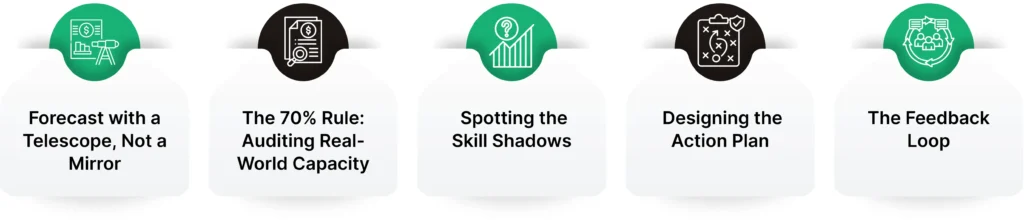
1. Forecast with a Telescope, Not a Mirror
Most recruitment planning fails because it looks backward. To win in 2026, you must analyze market signals to anticipate the scope and scale of work coming down the pipe next month, not last year. The goal is to understand the quality standards required before the first job description is ever written.
2. The 70% Rule: Auditing Real-World Capacity
A common trap in early-year hiring priorities is assuming 100% availability. In reality, human beings aren’t machines. Between the coordination tax, your team is likely operating at 70-80% project capacity. If you plan for 100%, you are inadvertently planning for burnout.
3. Spotting the Skill Shadows
Compare your forecasted demand against your real-world capacity. Where are the Skill Shadows? These are your gaps, both quantitative (needing more hands) and qualitative (needing different brains). In strategic headcount planning, identifying a risk is just as valuable as identifying a need.
4. Designing the Action Plan
This is where you decide your hiring mix. Do you solve the gap with a permanent hire, or is this the moment for flexible staffing solutions? By weighing temporary vs. permanent hires, you can protect the business from long-term overhead while ensuring the work gets done. Sometimes, outsourcing hiring support for a specific project is the bravest and smartest move a leader can make.
5. The Feedback Loop
Treat your January hiring strategy as a prototype, not a finished product. Hold regular “Capacity Pulses” to refine your estimations based on real-time performance data.
The Overcommitment Trap: How to Stay Lean Without Starving
Even the best capacity planning in hiring can fall victim to “Optimism Bias.” Leaders often get sucked back into the trap of over-promising and under-delivering. To maintain staffing without long-term commitment, you must master three defensive tactics:
- Aggressive Prioritization: Focus on high-impact, high-value work. By limiting “Work In Progress”, your team achieves a higher completion rate and builds the kind of momentum that a bloated, distracted team never could.
- The Strategic Buffer: Factor in the hidden delays, scope creep, technical debt, and the unexpected. Operating at a sustainable 85% utilization allows your team to absorb shocks without the entire system collapsing.
- Data Over Gut Feelings: Replace “I think we can do this” with “Our data shows we can.” Rely on past data and cycle times to make predictions. In 2026, the most successful leaders are those who trade optimistic gut feelings for data-driven reality.
Headcount vs. Capacity
Early-Year Hiring Priorities: The 2026 Trends to Master
As we move deeper into the first quarter, early-year hiring priorities are undergoing a radical shift. In 2025, the market was flooded with unique technical skills that have now become a surplus. Today, the challenge is finding the right person who won’t become a liability in six months.
To refine your hiring strategy for 2026, focus on these three trends when recruitment planning.
Trend #1: Critical Thinking Over AI Skills
The AI certification excess of 2025 has left us with resumes saturated with “Prompt Engineers.” But in 2026, the novelty has worn off, and the reality check has arrived: credentials don’t equate to competence.
According to Korn Ferry, 73% of talent acquisition leaders now rank critical thinking as their #1 priority, while technical AI skills have tumbled to fifth place.
In a world where ChatGPT can provide an instant answer, the real value lies in knowing if that answer is actually right. As automation accelerates, your January hiring strategy should pivot toward those who can distinguish a brilliant campaign from a hallucinated one.
Trend #2: The Silent Risk of Eliminating Entry-Level Roles
There is a dangerous temptation in 2026 to automate entry-level roles out of existence. It looks great on a balance sheet today, lower payroll and leaner operations, but it’s a short-sighted play that risks a future leadership crisis.
Entry-level roles are more than just support. They are the proving grounds where your future VPs learn the company structure, soft skills, and institutional judgment. By cutting these rungs off the ladder, you are effectively starving your own leadership pipeline.
The smarter approach is to re-imagine these roles. Instead of replacing the junior analyst with an AI agent, use flexible staffing solutions to pair young talent with AI tools. This preserves your culture while modernizing your efficiency.
Trend #3: Talent Acquisition is Driving Strategic Headcount Planning
For years, recruitment was seen as a support function, a cost center tucked away in HR. In 2026, that wall had crumbled.
Korn Ferry reports that 83% of TA leaders now directly influence the C-suite. The most successful recruiters have stopped filling roles and started managing capacity planning in hiring. This is the ultimate evolution: Recruiters are now the architects of the organization’s future growth.
Trend #4: Why Strategic Planning Beats Reactive Hiring in 2026
In the old world of hiring, when a resignation landed on a desk, we rushed to post a job ad. But when you wait for a vacancy to appear before you start looking, you are losing time and market share.
Strategic planning in 2026 is moving toward a Continuous Sourcing model. This is the competitive edge, proactive hiring anticipates the gaps before they become craters. By focusing on capacity planning year-round, you eliminate the vacuum period where roles sit empty for 60+ days. This is staffing without long-term commitment. In 2026, the best “Welcome” is the one you planned six months ago.
The Path Forward: How to Turn Capacity into a Competitive Advantage
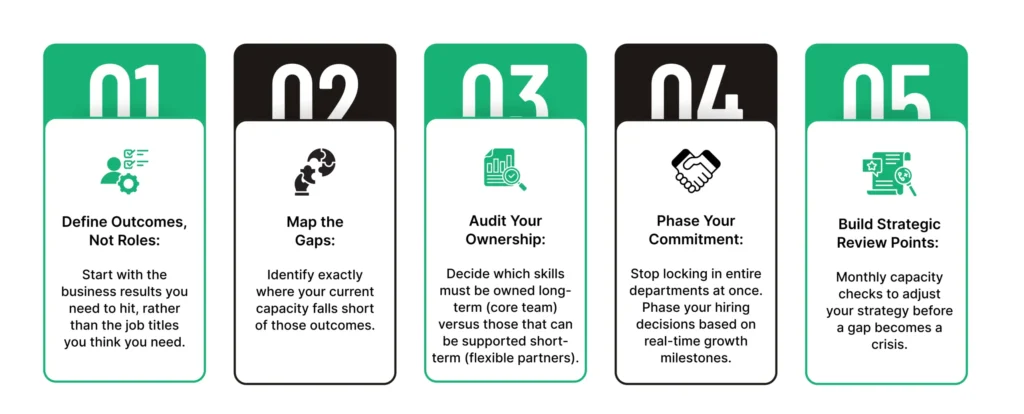
Strategic planning begins today to secure a competitive edge tomorrow. To move from a reactive mode to a strategic capacity model, follow these five steps:
- Define Outcomes, Not Roles: Start with the business results you need to hit, rather than the job titles you think you need.
- Map the Gaps: Identify exactly where your current capacity falls short of those outcomes.
- Audit Your Ownership: Decide which skills must be owned long-term (core team) versus those that can be supported short-term (flexible partners).
- Phase Your Commitment: Stop locking in entire departments at once. Phase your hiring decisions based on real-time growth milestones.
- Build Strategic Review Points: Monthly capacity checks to adjust your strategy before a gap becomes a crisis.
Final thoughts
The era of bloated headcounts and reactive recruiting is over. Success today belongs to the leaders who treat human capital with the same fluidity as their digital infrastructure.
By shifting your focus from headcount to capacity, and from credentials to critical thinking, you build a resilient organization that can pivot as fast as the market demands. The 2026 hiring strategy focuses on designing a workforce that creates its own momentum.
Start your reset with BPO W. today. Partner with us to turn your recruitment function into the strategic engine it was meant to be.