Table of Contents
You post a job ad, and within a week, your inbox is flooded with hundreds of applications. It’s January, so no surprise; everyone knows January and February are peak hiring months. (Indeed)
But then the problem comes after. Most applicants aren’t the right fit, some ghost after a single email, and the few who look promising are already hired by someone else. Welcome to hiring in 2026; a whole new ball game.
So, what can one do when the rules keep changing? Ideally, you would want someone to hand you a cheat sheet. We heard you, and we’ve got exactly that: your 2026 hiring reset checklist.
Why You Need a Hiring Reset
Talent these days doesn’t treat a job as an obligation. They are looking at it as something that helps them grow and a company that actually gets them. So the age-old work rules are somewhat changing now. Candidates are faster, savvier, and more selective than ever.
79% of recruiters found finding qualified talent more challenging in 2025. (LinkedIn)
If your hiring strategy hasn’t been refreshed in the last two years, you’re probably losing top talent without even realizing it. The cost you pay for it is slower hires and frustrated teams. 2026 is the year to hit the reset button.
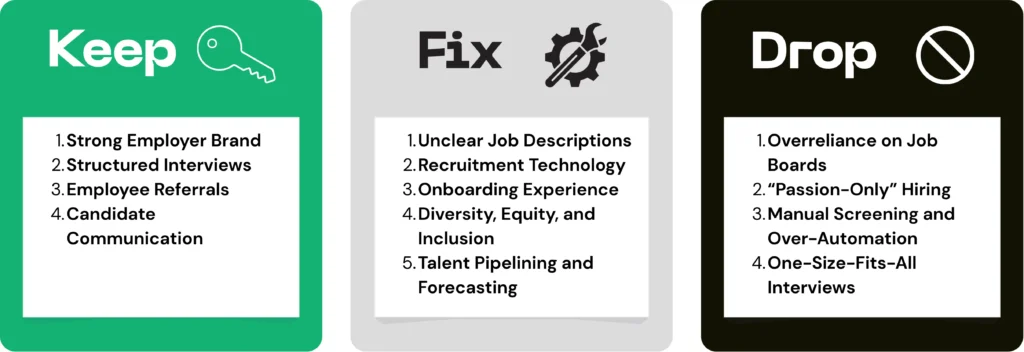
Keep: What Still Works
Not everything’s broken. Some practices have stood the test of time and are still very much applicable. Here’s what you definitely want to keep:
1. Strong Employer Brand
Gone are the days when the employer brand was only signified as a tagline. It is why candidates choose you over a competitor.

If your employer brand is more about showcasing your culture and being transparent, you’ve got it right. What can add to it is your team members sharing their side of stories. Encourage them to talk about their day-to-day experiences on social media or your careers page.
2. Structured Interviews
Behavioral interviews and skills assessments are still a must. They make hiring fairer and help predict who’ll actually succeed in the role.
Evaluate your current interviewing pattern. Are the interviews consistent? Are they testing what matters most? If yes, keep this pattern.
3. Employee Referrals
Referred candidates are 15 times more likely to get hired because they already know the culture and can start working from the get-go. Referral candidates are more credible when coming from your employees.
If you don’t have a referral program, start one and make it exciting. Give your team incentives for bringing in the people who become a good addition to your team.
4. Candidate Communication
Keeping candidates in the loop is a must. No one likes being left hanging after an interview. Send them updates at every stage and be clear about next steps. One thing that actually helps is making your messages feel personal and human. These small touches go a long way.
Fix: What Needs an Upgrade
Now let’s talk about things that aren’t necessarily broken, but they could use a little glow-up.
1. Unclear Job Description
A job description saying “Looking for a rockstar” is not enough anymore. Candidates want to know what the role is, how they can grow, and that they’ll feel included.
Give a fresher look to your job descriptions. Use tools to flag biased or exclusive language, and then give them a human touch so they feel real and welcoming.
2. Recruitment Technology
If your ATS still feels like it’s from the Stone Age, it’s the main factor that is slowing you down. Upgrade your tools to the modern sourcing platforms and AI-assisted screening. But it doesn’t mean that you let tech do all the work. A human eye on the final shortlist makes sure you’ve selected the right people, not just the right keywords.
3. Onboarding Experience
First impressions stick. A boring or poorly planned onboarding can make new hires leave before they’ve even started.

So plan these first 30 days well. Make sure the candidates get clear check-ins from managers and defined milestones for learning. Also, celebrate small moments and wins that will make them feel welcomed and part of the team.
4. Diversity, Equity, and Inclusion
You can’t treat DEI as a perk when it is actually table stakes. So if your hiring process is biased or your pipelines are too narrow, you are missing out on the best talent. Make sure your culture speaks that it values diversity, equity, and inclusion. Make adjustments to your DEI goals and track the progress regularly so your hiring actually reflects the world your company wants to be a part of.
5. Talent Pipelining and Forecasting
Waiting until you have a vacancy to start looking for candidates will only lead to chaos.
Keep a warm pool of talent and review your pipeline every few months. That way, when a role opens up, you already have the right people lined up.
Drop: What No Longer Works
Some old habits that have been there for too long, and now letting them go for your own growth is the only option.
1. Overreliance on Job Boards
Posting the same role on every job board won’t give you better candidates. It’s just more noise to sift through. Most great talent isn’t actively applying anyway. Instead, focus more on referrals and niche communities where the right people already are.
Step 4: Activate Employee Voices
A huge mistake companies make is trying to manufacture employee advocacy. Templates, scripts, or mandatory resharing programs almost always backfire.
You can give them topics or prompts that encourage natural storytelling. Some basic questions that you can begin with:
- “What’s a project you’re most proud of this quarter?”
- “What’s something you learned recently that surprised you?”
- “What’s a mistake that taught you something valuable?”
By giving employees the freedom to tell their stories within these prompts, your brand stops feeling like marketing and starts feeling like reality. Potential candidates scrolling through LinkedIn want to see more genuine experiences.
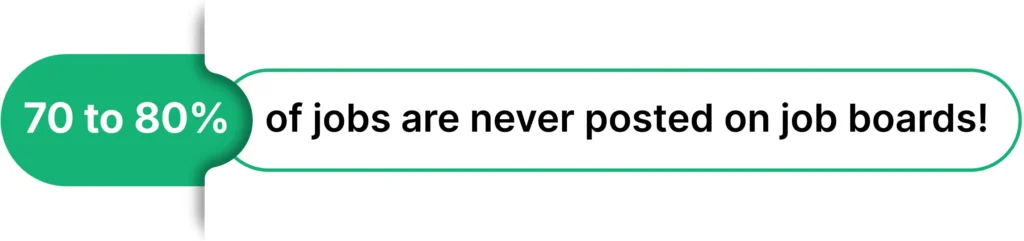
There’s this concept of the hidden job market where 70 to 80% of jobs are never posted on job boards. They’re filled through referrals, internal moves, networking, or recruiters.
2. “Passion-Only” Hiring
Yes, passion sounds great on paper. However, hiring someone simply because they’re “excited” about the industry doesn’t always mean they can give effective performance.
Passion without skills usually falls flat. It’s better to look for people who are quick learners and can actually do the job. Passion follows when the fit is right.
3. Manual Screening and Over-Automation
Manually reviewing every resume takes so much time, but handing everything over to automation isn’t the answer either. Too much manual work slows you down, and too much AI can filter out great candidates for the wrong reasons.
The perfect balance is to use AI to speed things up, but keep humans involved where judgment is needed.
4. One-Size-Fits-All Interviews
We all know that every role doesn’t need the same interview questions or format, yet many companies still treat interviews like a template. That rigidity can cost you great hires.
If you want your company’s growth, drop the cookie-cutter approach. Treat interviews like a conversation where you talk about skills, real scenarios, and what the other person can bring to the table.
Bottom Line
Hiring in 2026 is knowing what to keep, what needs upgradation, and what won’t work anymore. If your company can pull off this reset, you’ve already won the talent war.
It’s more like decluttering your closet: some pieces are classics, some just need tailoring, and some… well, you’re never wearing them again.
So, take your leadership team, print out the checklist, and start your reset. Because the best talent in 2026? They’re not waiting around for companies that are still stuck in 2022 hiring habits. And, if along the way you think you need a hand with it, BPO Wizard’s RPO services are just a click away.
FAQs:
A hiring reset checklist is a blueprint that helps you analyse and improve your recruitment process. It can help you identify what’s working, what needs fixing, and what should be dropped so that it aligns better with modern talent strategy and recruitment best practices in 2026.
The hiring landscape is changing every day with new trends in AI, hybrid work, and newer candidate expectations. A talent strategy reset makes sure that your processes are up-to-date and efficient enough to attract and retain top talent.
The checklist makes it simple to see what’s working, what needs a fix, and what’s just not worth the effort. It will help you communicate better with candidates and overall fine-tune your recruitment process so that you spend less time chasing resumes and more time hiring the right people.
A recruitment audit checklist is a step-by-step look at your hiring process. You check your job descriptions, see where candidates are coming from, look at how interviews and onboarding feel, and track things like time-to-hire and diversity. It helps you spot what’s working and what needs a fix.